How much weight can overhead storage hold?
The rack rating is only half the number. Joist size, spacing, anchor type, and load distribution decide what an overhead rack can actually hold.
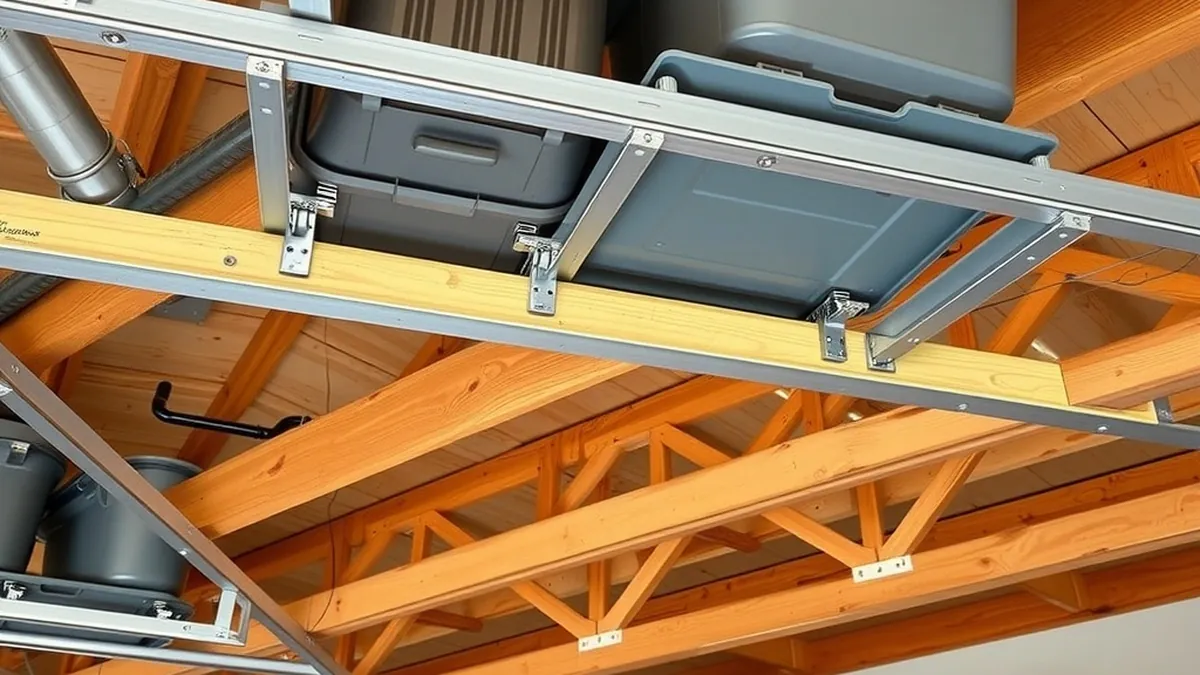
A rack's label gives its total capacity under an evenly spread load. The ceiling may be the lower limit: joists sized for drywall and insulation are often not rated for storage, and drywall anchors never are.
- Rating basis
- Total load, evenly distributed
- Typical joist spacing
- 16 or 24 in on center
- Minimum anchor
- Lag or structural screw into a joist
- Planning margin
- 80 percent of the rack rating
Some links on this page are affiliate links.If you buy through them we may earn a commission at no extra cost to you. We do not accept payment for rankings. Read the full disclosure.
An overhead rack rarely fails because the rack is weak. It fails at the four or six points where the rack meets the ceiling, and the ceiling is usually the least understood part of the system.
An overhead storage rack is a platform hung from ceiling joists or another rated structure, loaded from below, and rated as a total capacity when the weight is spread across the deck.
The rating is a total, not a point
A 500-pound rack does not hold 500 pounds on one corner. The rating assumes the load is distributed across the deck and the fasteners share it. Put a 300-pound engine block in one corner and the deck, the bracket, and one joist take a load the rating never described.
Use the rating as a ceiling for the whole rack, then keep heavy items over the brackets and light, bulky items in the middle. A rack loaded with six 40-pound totes is a different structure from the same rack loaded with one 240-pound crate, even though the scale reads the same.
What the joists can carry
Garage ceilings are built in three common ways: ceiling joists with attic space above, the bottom chord of a manufactured truss, and a floor structure for a room above. Each behaves differently.
Building codes separate ceiling joists designed for an uninhabitable attic without storage from those designed for limited storage. The IRC ceiling joist tables use a higher design load for the storage case, and an inspector will look for that distinction. A joist that was sized for drywall and insulation has no spare capacity just because it looks solid.
A truss bottom chord is not a storage beam. Many truss design drawings say “no storage” or limit the load to the ceiling finish. If the ceiling is a truss and you do not have the design drawing, treat it as no-storage until an engineer says otherwise.
The practical check is span and size. A 2 × 6 ceiling joist spanning 12 feet is doing more work than a 2 × 8 spanning 10 feet, and neither number tells you the species or grade. A span table plus the stamp on the lumber is the minimum; an engineer is the answer for a heavy rack.
Rack types and typical ratings
The ranges below are estimates for planning, not published ratings for any specific product. Consumer racks commonly fall in these bands; the label on the unit you buy governs, and every number assumes installation into framing the manufacturer considers adequate.
| Rack type | Typical range (estimate) | Rating basis | Best for |
|---|---|---|---|
| Light shelf rack, 2 × 4 ft | 150–250 lb | Total, evenly distributed | Paint, small totes |
| Ceiling rack, 4 × 4 ft | 300–400 lb | Total, four brackets | Seasonal bins |
| Heavy ceiling rack, 4 × 8 ft | 500–600 lb | Total, six brackets | Bulky light items |
| Wire shelf, wall-mounted | 150–250 lb | Per shelf, evenly loaded | Small boxes |
| Site-built wood rack | No published rating | Design-specific | Only with a stamped plan |
A site-built rack has no label, so its capacity is whatever the design says. Joist hangers, lag screws, and a ledger board are structural work. If you are not working from a plan, use a rated product instead.
The anchor is the weakest link
Overhead racks hang from fasteners, and the fastener is usually the smallest steel in the system. Most manufacturers specify a lag screw or a structural screw into the center of a joist. Follow that specification exactly, including the pilot hole and the minimum embedment.
Never substitute a toggle bolt, a plastic anchor, or a hollow-wall anchor for overhead storage. Those anchors are designed for light loads in drywall or hollow walls, not for a rack full of totes.
Two fasteners per bracket, not one. A single screw lets the bracket rotate, and rotation puts a prying load on the joist that the screw was never designed to take.
If the ceiling is concrete, the anchor changes completely. Use a rated concrete anchor and the manufacturer’s pattern, and do not drill into a post-tensioned slab without an engineer.
Load distribution and the 80 percent habit
Keep the total at or below 80 percent of the rack rating. The margin covers the fact that totes are heavier than the label says and that loads shift when a box is added at the front.
Spread weight across as many joists as the rack crosses. A 4-foot rack running perpendicular to joists at 16 inches on center crosses three or four joists; the same rack running parallel to them may cross only two.
Put the heaviest items directly over the brackets. Keep the middle for light, bulky things. Do not stack to the ceiling; leave 6 inches so you can see the deck and inspect it.
The drywall warning
Drywall is a 1/2-inch sheet of gypsum and paper. It has almost no pull-out strength, and it fails suddenly. A 50-pound load on four toggle bolts is 12.5 pounds per bolt only until the paper tears, and then the whole load is moving.
Ceiling drywall also hides the joist. Use a stud finder, confirm the finding with a small probe or from the attic, and mark both edges of every joist before drilling. Missing a joist by an inch puts the screw in air.
Do not hang anything from the drywall, and do not add a plywood panel to the ceiling to “spread the load” unless the panel is screwed into the joists and the design accounts for the extra weight. A backer panel can help a wall cabinet; it is not a substitute for framing on a ceiling.
Inspection, once a year
Check the rack every year and after any load change. Look for a gap between the bracket and the ceiling, a bent bracket, a rusty fastener, a deck that has bowed, or a screw that has started to withdraw.
Put a hand on the rack and push gently. A rack that moves independently of the ceiling is loose. A rack that creaks when the temperature changes is usually fine, but a new creak after loading deserves a look.
If you find a pulled screw, do not simply move it 2 inches and reinstall. The joist is now damaged at that point, and the fix is a larger fastener or a new location, chosen with the rack manufacturer’s guidance. A cracked or split joist is a job for a contractor.
The short version
Add up the load, compare it to the rack label, and then check the ceiling. If the joists are trusses without a storage rating, the answer is no regardless of the rack. If the joists are adequate, use the specified fasteners into the center of the joists, keep the load under 80 percent of the rating, and inspect once a year.
The ceiling types guide explains how to identify what you have, and the garage storage safety checklist covers the rest of the room. If the garage is tight as well as the ceiling, the small-garage layout guide shows where a rack can go without closing the walkway.
How to do it
- Map the joistsFind the joist centers with a stud finder and confirm them with a probe or from the attic. Mark both edges of every joist.
- Total the loadAdd the weight of every bin, the rack itself, and anything that will hang from it. Do not use the volume of the bin as a proxy.
- Compare rack and ceilingCheck the rack's published total against the load, then confirm the joists are rated for storage. The lower number governs.
- Install with the specified fastenersUse the lag or structural screws the manufacturer specifies, into the center of each joist, with two fasteners per bracket.
- Load evenly and inspectKeep the heaviest items over the brackets, stay under 80 percent of the rating, and check the anchors once a year.
Frequently asked questions
How much weight can a garage ceiling hold?
There is no single number. It depends on joist size, species, span, spacing, and what the ceiling already carries. A truss bottom chord is usually not rated for storage at all.
Does the rack rating include the weight of the rack?
Usually not. The published capacity normally describes the load on the deck. If the label says the rating includes the rack, subtract the rack's own weight before loading it.
Can I hang a 500-pound rack from four joists?
Only if the joists are rated for the added load and the brackets land on their centers. Four joists at 16 inches on center spread 500 pounds to 125 pounds each, before the rack's own weight.
Are lag bolts into a joist strong enough for overhead storage?
Lag screws or structural screws into the center of a joist are the usual specification. The size, embedment, and count come from the rack manufacturer, and substituting a drywall anchor is not acceptable.
What happens if I overload an overhead rack?
The deck sags first, then a bracket pulls, then the fastener or the joist fails. The failure is sudden and the load falls, which is why the margin and the yearly inspection matter.
Do I need an engineer to install an overhead rack?
Not for a rated rack installed into sound, exposed joists per the instructions. You do need one if the ceiling is a truss, a steel beam, or a finished assembly you cannot identify.
Sources
Some links are affiliate links.If you buy through them we may earn a commission at no extra cost to you. We do not accept payment for rankings. Read the full disclosure.