Best garage wall organizers
Five garage wall organizer systems compared by published load rating, wall coverage, and install method, from steel rails to PVC slatwall.
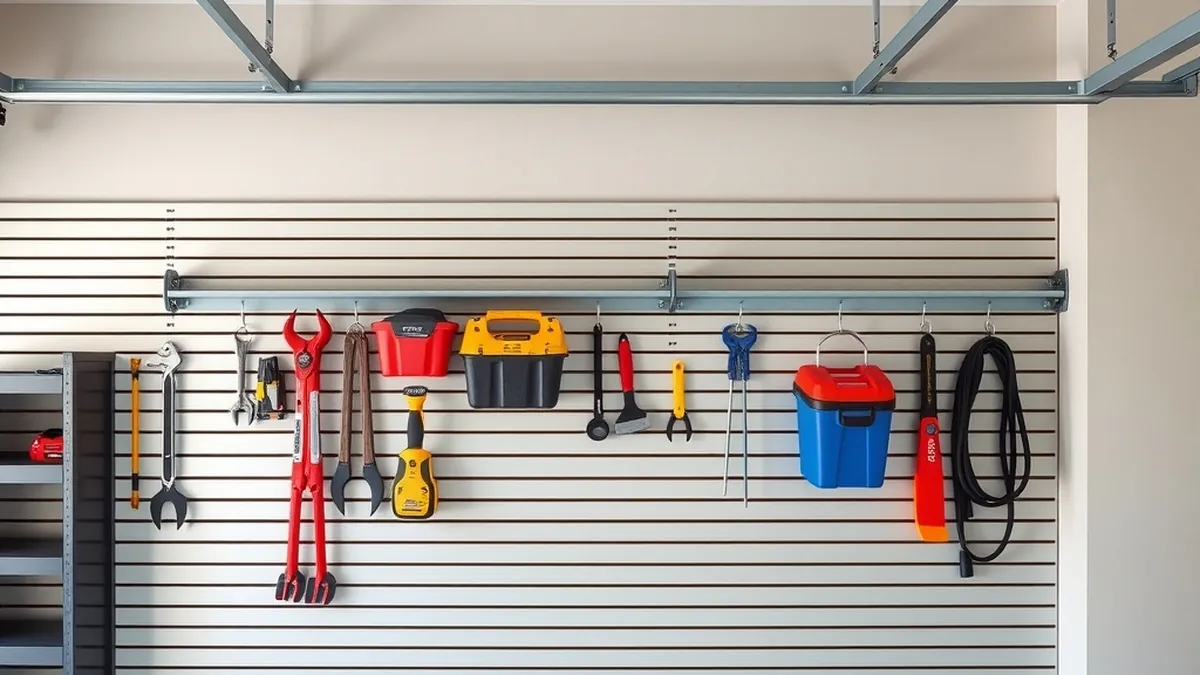
For most garages, start with a steel rail: it fastens into studs, costs less than full slatwall, and lets hooks move as storage changes. Choose slatwall for full-wall coverage, and pegboard only for light tools.
- Best overall
- Rubbermaid FastTrack rail
- Best full-wall system
- Gladiator GearWall
- Best value slatwall
- Proslat PVC panel
- Best budget rail
- Wallmaster 8-ft organizer
- Best finished look
- NewAge PVC slatwall
Some links on this page are affiliate links.If you buy through them we may earn a commission at no extra cost to you. We do not accept payment for rankings. Read the full disclosure.
The best garage wall organizer for most people is a steel rail system, not a full wall of slatwall. A 48-inch rail fastens into three studs, starts around $30 before hooks, and lets you slide or add hooks as the garage changes. Slatwall wins when you want every square foot covered and a finished look; pegboard is for light tools and tight budgets.
A garage wall organizer is any system that turns wall area into hanging storage: a horizontal rail, a grooved panel, or a perforated board, plus the hooks, baskets, and shelves that attach to it.
The three systems in one table
| System | What it is | Published load basis | Entry cost for about 16 sq ft | Best for |
|---|---|---|---|---|
| Steel rail | A horizontal channel screwed into studs; hooks snap on | Often listed per rail, from about 265 to 1,750 lb | $70 to $120 with hooks | Most garages, long tools, bikes, ladders |
| Slatwall | Grooved panels covering the wall; hooks lock into the grooves | Commonly 50 to 75 lb per sq ft, evenly distributed | $130 to $240 for panels | Full-wall coverage, finished look, heavy small items |
| Pegboard | 1/8 or 1/4 in. hardboard with holes on a grid | No meaningful structural rating; light duty only | $40 to $80 with hooks | Screwdrivers, pliers, small parts |
Those are typical street prices in late 2026, not quotes; they exclude fasteners, trim, and extra hooks.
Measure before you buy
Start with usable wall length, not the garage’s outside dimensions. A 20-foot wall with a 16-foot door leaves about 2 feet on each side. Measure the gaps between the door track, opener rail, service door, and outlets.
Find the studs and note spacing. Most garage walls are framed at 16 or 24 inches on center, and direction matters: a horizontal rail crosses studs, while a vertical panel may miss them.
Check the depth you can lose. Slatwall adds about 3/4 inch, but hooks stick out 6 to 12 inches, so a wall beside a car door needs room for the door to open. Look up too: an 8- to 9-foot ceiling is typical, and the door track often sits at 6 feet 8 inches to 7 feet.
Rail systems: the best first purchase
A rail is the least expensive way to get real load capacity. The rail is a steel channel; you screw it through the drywall into studs, then snap hooks, baskets, and shelves onto it. Because the hooks move, a rail adapts when you buy a taller ladder or swap bikes.
The published numbers need context. Rubbermaid lists up to 1,750 pounds per 48-inch FastTrack rail when properly installed, and Wallmaster lists 265 pounds for its 8-foot rail. Those are rail capacities, not hook capacities, and they assume sound studs and the specified fasteners. A single hook holding a 100-pound ladder is a point load, so check the hook’s own rating too.
Rails look industrial; slatwall gives a cleaner backdrop.
For a direct comparison of the two most common rail systems, see Rubbermaid FastTrack vs Gladiator.
Slatwall and pegboard
Slatwall is a panel with horizontal grooves cut into it. Hooks and brackets engage the grooves at any point, so you can build a wall of storage without committing to hook positions. PVC panels are the common garage version: they resist moisture, do not need painting, and can be cut with a circular saw or jigsaw.
The published capacities are per square foot and assume even distribution. Gladiator rates GearWall at 50 pounds per square foot; Proslat and NewAge rate their PVC panels at 75 pounds per square foot. A 4-by-8-foot Proslat panel is 32 square feet, so the evenly distributed figure is 2,400 pounds. That does not mean you can hang a 2,400-pound item from one hook.
Coverage is the real advantage. A 16-foot wall with 4-foot-high panels gives 64 square feet of storage surface, enough for garden tools, bike gear, and seasonal bins on one plane. The tradeoff is cost: panels must be screwed into studs or blocking, and trim, hooks, and baskets add 20 to 40 percent to the panel price.
Pegboard is the cheap alternative: 1/8- or 1/4-inch hardboard with a grid of holes. It is fine for screwdrivers, pliers, and small bins, but a poor choice for a ladder, a bike, or a 40-pound tote because the board can tear around a hook. If you use it, choose 1/4-inch board, screw it to furring strips fastened to studs, and keep a 1/2-inch air gap behind it.
The panel types are compared in slatwall vs pegboard.
The five picks
Gladiator GearWall is the strongest full-wall pick for most buyers. The 8-foot panels are 12 inches tall; a two-pack covers 16 square feet at 50 pounds per square foot, and the hook range is the broadest here.
Rubbermaid FastTrack is the best first rail. The 48-inch rail is rated up to 1,750 pounds, the accessories snap on without tools, and hooks are easy to find.
Wallmaster is the budget rail for long tools. The 8-foot organizer lists a 265-pound rail capacity and costs less than half a premium slatwall panel.
Proslat is the value slatwall panel. One 8-by-4-foot panel covers 32 square feet at 75 pounds per square foot, and the PVC can be cut and trimmed like wood. Budget for trim and hooks.
NewAge is the finished-look pick. The 40-square-foot box holds six 80-inch panels, rates at 75 pounds per square foot, and matches NewAge cabinet finishes if you plan a full garage system.
For the shelving that goes with a wall system, see best garage shelving.
Anchoring and load limits
Every system depends on what it is screwed into. A rail or panel must fasten into wood studs, blocking between studs, or concrete with the correct anchor. Drywall anchors are not a substitute; they are rated for a fraction of the pull-out load hanging storage creates.
Use the manufacturer’s fasteners. For wood studs, that usually means lag screws long enough to reach the stud’s center. For concrete, use wedge anchors or masonry screws sized to the hole; do not over-torque and crack the concrete.
The load path matters as much as the fastener. A 50-pound-per-square-foot panel rating assumes the load is spread across the panel. Hanging a 120-pound ladder from two hooks concentrates the force at two points, so the hook rating and the stud behind it control the safe load.
Garage walls can hide wiring, plumbing, and gas lines. Use a stud finder with an AC mode, keep fasteners away from outlets and switches, and call a licensed electrician to move anything electrical. If a wall is cracked, bowed, or covered in unknown paneling, have it assessed before you drill.
The short version
Buy a steel rail first if you want the most storage for the least money. Add slatwall when you want full-wall coverage or a finished look, and use pegboard only for light tools. Whatever you choose, fasten into studs or rated concrete anchors, respect the published capacity, and keep point loads within the hook’s rating.
For a small garage, pair a wall system with the layout advice in garage storage for small garages, and price the whole project with garage storage costs before you order panels.
Our top picks
- + Published 50 lb per sq ft capacity
- + Panels cover 16 sq ft as a pair
- + Large hook and basket ecosystem
- − Accessories add up quickly
- − Panels must land on studs or blocking
- + Published capacity up to 1,750 lb per rail
- + Hooks snap on and slide
- + Widely available accessories
- − Hook ratings are lower than rail rating
- − Needs solid stud contact
- + 8 ft of rail for a low entry price
- + Published 265 lb rail capacity
- + Sliding, removable hooks
- − Fewer specialty accessories
- − Finish is utilitarian
- + 32 sq ft per 8 by 4 panel
- + Published 75 lb per sq ft capacity
- + Cuts with common woodworking tools
- − Trim and hooks sold separately
- − Large panels are awkward solo
- + 40 sq ft per box
- + Published 75 lb per sq ft capacity
- + Coordinates with NewAge cabinet finishes
- − Premium price per box
- − Best value only on larger walls
Frequently asked questions
Do garage wall organizers have to be screwed into studs?
Yes. Hanging storage puts a pull-out load on the wall, and drywall alone is not rated for it. Fasten rails and panels into wood studs, into blocking you added between studs, or into concrete with the anchor type the manufacturer specifies.
Is slatwall better than pegboard for a garage?
For most garages, yes. Slatwall carries heavier loads and accepts hooks, baskets, and shelves without the board tearing out. Pegboard is fine for screwdrivers, pliers, and other light tools, but it is a poor choice for ladders, bikes, and totes.
How much weight can a garage wall organizer hold?
It depends on the system and the fastener. Published panel ratings are commonly 50 to 75 pounds per square foot when evenly distributed, while a rail may list a per-rail capacity in the hundreds or thousands of pounds. The hook, the stud, and the anchor are usually the limiting parts.
Can I install slatwall over drywall?
Yes, provided the screws pass through the drywall and into studs or rated blocking. Do not rely on the drywall itself. If the studs do not line up with the panel's mounting points, add horizontal blocking first or choose a panel designed for 16-inch stud spacing.
What is the cheapest wall organizer for a garage?
Pegboard is the cheapest material, followed by a single steel rail with a few hooks. A 4-by-8-foot sheet of pegboard, furring strips, and a starter hook set can cost less than one premium slatwall panel, but it carries far less weight.
Can I mount a wall organizer on a concrete garage wall?
Yes, with anchors made for concrete, such as wedge anchors or masonry screws. Stay out of mortar joints in block walls, and use a hammer drill with the correct bit size. If the wall is cracked or the block is hollow, have a professional assess it first.
Sources
Some links are affiliate links.If you buy through them we may earn a commission at no extra cost to you. We do not accept payment for rankings. Read the full disclosure.