Best garage shelving
Five garage shelving units compared by material, published load per shelf, depth, and adjustability, from welded steel racks to resin units.
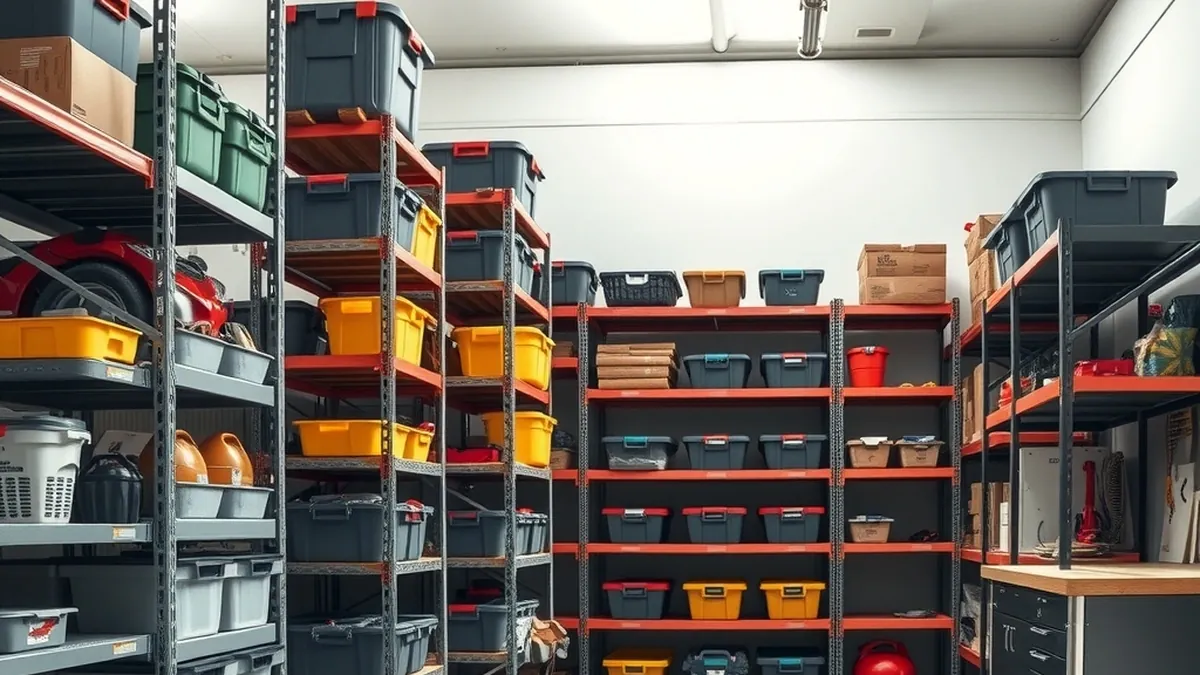
Welded steel is the best garage shelving for most homes: it carries the heaviest loads, resists temperature swings, and costs less per pound of capacity than resin. Choose wire for airflow and resin only for light bins.
- Best overall
- Gladiator 77 in. rack
- Heaviest per shelf
- Husky 77 in. rack
- Best wire shelving
- Seville Classics 5-tier
- Best value steel
- Muscle Rack 5-shelf
- Best light-duty
- HDX 5-tier resin
Some links on this page are affiliate links.If you buy through them we may earn a commission at no extra cost to you. We do not accept payment for rankings. Read the full disclosure.
Welded steel is the best garage shelving for most homes. It carries the heaviest loads, holds its shape through temperature swings, and costs less per pound of capacity than resin or wire. Wire shelving is the better choice when you need airflow or light; resin is for light bins, seasonal decor, and rentals where the rack may move.
Garage shelving is a freestanding or wall-mounted set of horizontal shelves on posts, brackets, or a frame, rated by how much weight each shelf carries when the load is spread evenly.
Wire, resin, or steel
| Type | Typical published capacity per shelf | Cost for a 4- or 5-tier unit | Best for | Watch out for |
|---|---|---|---|---|
| Welded steel | 650 to 2,500 lb | $200 to $450 | Totes, tools, bulk goods, heavy equipment | Weight, sharp edges, assembly effort |
| Steel wire | 200 to 800 lb | $100 to $260 | Paint, chemicals, damp gear, ventilated storage | Small items fall through; point loads |
| Resin | 66 to 150 lb | $40 to $100 | Light bins, seasonal items, rentals | Low capacity; bows under heat and load |
The ranges are drawn from published ratings on current models, not from a single test. A cheap steel rack and a premium one can differ by a factor of three, so read the label on the exact unit.
Load per shelf is not total capacity
Two numbers matter, and they are not interchangeable. The per-shelf rating tells you what one shelf can carry when the weight is spread across it. The total unit rating tells you what the frame, posts, and feet can carry together.
A Gladiator 77-inch rack lists 2,000 pounds per shelf and 8,000 pounds total across four shelves. A Seville Classics five-tier wire unit lists 800 pounds per shelf and 4,000 pounds total on leveling feet, but only 500 pounds total on its wheels. An HDX resin unit lists 150 pounds per shelf and 750 pounds total.
The lowest relevant number governs. If you put 800 pounds on each of five Seville shelves, you would be at 4,000 pounds, which is the unit limit on feet and eight times the limit on wheels. If you plan to move the rack, rate it for the wheel figure.
Floor loading is the second check. A 77-by-24-inch rack has about 12.8 square feet of footprint. Spreading 8,000 pounds over that area averages roughly 625 pounds per square foot, and the load lands on four feet. That is a lot for a suspended floor and usually fine on a slab-on-grade garage, but have an engineer review anything unusual.
Depth: 18 inches or 24 inches
Depth decides what the shelf can hold. An 18-inch shelf fits standard 15- to 18-inch bins and leaves more aisle. A 24-inch shelf holds coolers, large tool cases, and two rows of smaller bins, but it projects farther into the parking space.
Measure the car door swing before you buy. A 24-inch rack on the wall beside a car needs roughly 24 inches plus the door’s swing to open fully. If the garage is tight, put the deep rack on the back wall and keep 18-inch units on the side walls.
Leave at least 30 inches of aisle in front of the rack. Thirty-six inches is better if you will pull totes in and out, and it is the difference between a usable aisle and a shuffle.
For a layout that fits both cars, see garage storage for small garages.
Adjustability and mobility
Shelf height matters more than most buyers expect. Bins are not uniform, and a fixed shelf spacing of 14 inches will not take a 16-inch tote. Look for shelves that adjust in 1-inch increments, or at least in 2-inch steps, and check the lowest position so the bottom shelf clears a floor slope.
Casters are convenient and costly in capacity. The Seville unit is a clear example: 4,000 pounds on leveling feet, 500 pounds on wheels. The wheels are fine for a rolling pantry or light garage shelf; they are not fine for engine parts.
If you need mobility, buy a unit with locking casters, keep the heavy items on the bottom shelf, and empty the top before rolling. Move it on a smooth slab, not across a threshold or a floor drain.
The five picks
Gladiator’s 77-inch rack is the best overall steel unit. Four 24-inch-deep shelves, 2,000 pounds per shelf, 8,000 pounds total, and tool-free assembly. It is the rack to buy if you want one wall of storage to handle everything and you do not plan to move it.
Husky’s 77-inch unit is the capacity leader. Husky publishes 2,500 pounds per shelf and 10,000 pounds total, with a welded I-beam frame. It is heavier and harder to assemble alone, but it is the pick for a workshop with dense loads.
Seville Classics’ five-tier wire unit is the best ventilated option. It publishes 800 pounds per shelf on feet, adjusts in 1-inch increments, and includes both wheels and leveling feet. Use shelf liners so small parts do not fall through.
Muscle Rack’s five-shelf unit is the value steel pick. At 48 inches wide and 24 inches deep, it fits a short wall, and it publishes 650 pounds per shelf and 3,900 pounds total. The particleboard shelves need to stay dry.
HDX’s five-tier resin unit is the light-duty pick. It assembles without tools, holds 150 pounds per shelf, and will not rust. It is the right choice for holiday bins and a rental garage, not for paint or tools.
Anchoring, slope, and safety
Even a freestanding rack should be restrained. A 72-inch unit loaded at the top can tip when a door hits it or a child pulls on it. Use the anti-tip strap or bracket that comes with the unit, and screw it into a stud, not drywall alone.
Garage slabs slope toward the door, often about 1/8 to 1/4 inch per foot. Shim the feet so the frame is level and all four points carry load. A rack that rocks on two feet will twist once it is loaded, and the shelves will not sit flat.
Keep the heaviest items between knee and chest height. Putting 80-pound totes on the top shelf raises the center of gravity and makes the rack harder to control. Distribute weight evenly front to back as well; a shelf loaded at the front edge puts a twisting load on the posts.
If the rack sits near a water heater, furnace, or electrical panel, keep the code-required clearances. The International Code Council publishes the model codes that most local codes draw from, and your local building department has the final say. For structural changes or a rack that will carry unusual loads, consult a professional.
The short version
Buy welded steel for heavy garage loads, wire for airflow, and resin only for light items. Compare the per-shelf rating, the total unit rating, and the depth before price. Anchor tall racks, shim them level, and keep the heavy weight low.
If you are still deciding between open shelves and closed storage, read garage cabinets vs shelves. To see what a full wall of storage costs, use the numbers in garage storage costs, and pair the racks with a garage wall organizer for tools and bikes.
Our top picks
- + Published 2,000 lb per shelf
- + 24 in. deep shelves hold totes
- + Tool-free assembly
- − Heavy to move once built
- − Premium price
- + Published 2,500 lb per shelf
- + Welded I-beam frame
- + 77 in. wide, 24 in. deep
- − Very heavy
- − Needs a helper for assembly
- + Published 800 lb per shelf on feet
- + Adjustable in 1 in. increments
- + Wheels and leveling feet included
- − Wire lets small items fall through
- − Only 18 in. deep
- + Published 650 lb per shelf
- + 48 in. wide fits short walls
- + Boltless assembly
- − Particleboard shelves dislike moisture
- − Less rigid than welded racks
- + No tools to assemble
- + Published 150 lb per shelf
- + Will not rust
- − Low total capacity
- − Can bow under sustained heat and load
Frequently asked questions
How much weight can garage shelving hold?
Check two numbers: the per-shelf rating and the total unit rating. A welded steel rack may list 2,000 pounds per shelf and 8,000 pounds total, while a resin unit may list 150 pounds per shelf and 750 pounds total. The lower number that applies to your load governs.
Is steel or wire shelving better for a garage?
Steel is better for heavy, bulky items and for a garage that sees temperature swings. Wire is better when you want airflow, light, and easy cleaning, such as for paint, chemicals, or damp gear. Wire concentrates point loads on fewer contact points, so use shelf liners for small items.
What depth should garage shelves be?
Twenty-four inches is the most useful depth for totes, coolers, and tool cases, but it eats floor space. Eighteen inches fits narrow walls and still holds standard bins. Measure the car door swing and leave at least 30 inches of aisle before choosing a deeper rack.
Do freestanding garage shelves need to be anchored?
Tall units should be strapped to a stud or to blocking, even when they are freestanding. A 72-inch rack loaded at the top can tip if a door or a child pulls on it. Use the manufacturer's anti-tip kit or a short strap screwed into a stud.
Can garage shelving sit on a sloped floor?
Yes, but shim the feet so the frame is level and all four feet carry load. Garage slabs commonly slope toward the door. A rack that rocks on two feet will twist under load, and a tall unit can lean. Check with a spirit level after loading.
Are casters worth it on garage shelving?
Only for light loads. Casters make a rack easy to move for cleaning or parking, but they cut capacity sharply: one five-tier wire unit is rated 4,000 pounds on leveling feet and 500 pounds on its wheels. Lock the casters and avoid rolling a loaded rack over a lip or slope.
Sources
Some links are affiliate links.If you buy through them we may earn a commission at no extra cost to you. We do not accept payment for rankings. Read the full disclosure.