Best overhead garage storage
Five ceiling racks compared by published load, drop range, and ceiling height: SafeRacks, Gladiator, Monkey Bars, Fleximounts, and HyLoft.
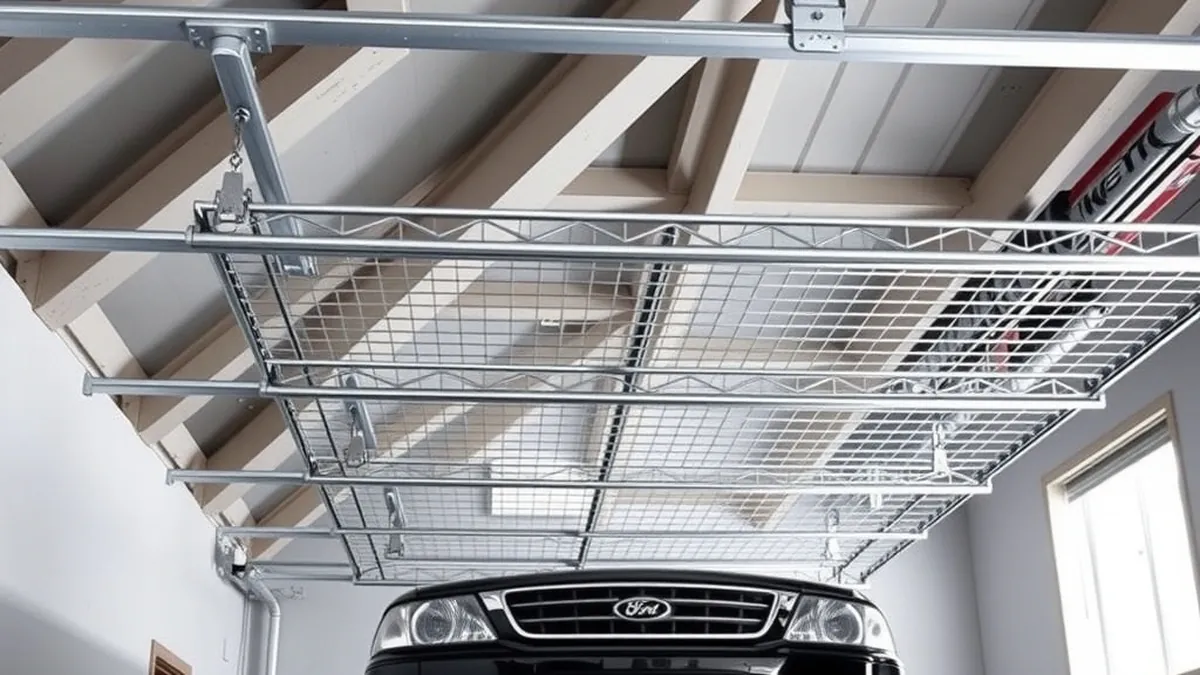
For most 8–9 ft garages, the SafeRacks 4x8 balances price and a 600 lb published capacity. For 1,000 lb, the Gladiator GearLoft is the strongest mainstream pick. Low ceilings need a 12–24 in drop.
- Best overall
- SafeRacks 4x8 — 600 lb, 12–45 in drop
- Best heavy load
- Gladiator GearLoft 4x8 — 1,000 lb
- Best installed
- Monkey Bars 4x8 platform
- Best small bay
- Fleximounts GR36 — 450 lb, 3x6 ft
- Best budget
- HyLoft 45x45 — 250 lb
Some links on this page are affiliate links.If you buy through them we may earn a commission at no extra cost to you. We do not accept payment for rankings. Read the full disclosure.
The best overhead garage rack is the one that fits your ceiling, your car, and your joists. Capacity gets the headlines, but drop range and clearance decide whether the rack is usable every day. Start with the ceiling height, then choose the load rating, then compare price.
An overhead garage rack is a ceiling-mounted platform that carries bins and bulky items above the floor, usually suspended from ceiling joists by brackets or hangers.
Start with ceiling height, not brand
An 8-foot ceiling is the common case. A 9-foot ceiling gives you more room to work, but the deck sits higher and may need a step ladder. A 10- to 12-foot ceiling can take a deeper drop, but loading it becomes a ladder job.
Measure at the lowest obstruction, not at the center of the room. Garage ceilings often have a beam, a duct, or a dropped section near the door. The rack needs a flat mounting plane across at least two joists, and the deck needs clearance to slide bins in from the side.
If the ceiling is finished drywall, find the joists with a stud finder and confirm with a small nail. Joist spacing is commonly 16 or 24 inches on center, and the direction matters: a 4-foot rack usually spans two joists across its width, not along its length.
The load question is about the ceiling
A rack rated for 600 pounds does not mean your ceiling can carry 600 pounds. The rating assumes the rack is fastened to joists or a rated structure with the specified hardware. The ceiling assembly, the joist span, and the condition of the wood all sit in the load path.
That is why the published number is a starting point, not a guarantee. If the ceiling is older, has been cut or notched, or carries another load, have a professional evaluate it. Never hang a rack from drywall, a suspended ceiling grid, or a single joist that has been compromised.
For a full explanation of the ceiling side, see /overhead-garage-storage-weight-limit/. The short version: the rack is the easy part to rate; the ceiling is the part that needs a site visit.
Ceiling height and drop: a fit table
| Ceiling height | Rack drop to plan for | What to check | | 7 ft | 12–24 in | Door track, opener rail, car roof | | 8–9 ft | 24–37 in | Car roof, door travel, ladder reach | | 10–12 ft | 37–45 in | Long hangers, loading access, lighting |
The drop is the distance from the ceiling to the lowest point of the rack. The ranges below are a starting point, not a rule for every rack. A rack with a 12-inch drop leaves more headroom but less space for tall bins. A 45-inch drop holds more, but it can put the deck at chest height and eat the clearance over a car.
Match the drop to the tallest item you plan to store, then add two inches for your hands. If the rack will sit above a car, measure the car’s roof height with the suspension loaded, not the brochure height.
Door clearance and the opener rail
The garage door is the obstacle people forget. The door track and opener rail often sit around 6 feet 8 inches to 7 feet, and the door panels travel up and back. A rack mounted near the door can block the door’s path or the opener’s arm.
Open the door fully and watch the highest point of the top panel. Then measure the space between that path and the ceiling. If the rack or its load crosses that line, move the rack toward the back of the garage or choose a shallower drop.
The same check applies to the opener rail. A rack that clears the closed door can still hit the rail when the door is open. Keep the rack at least a few inches clear of any moving part, and never hang anything from the door track itself.
Rack size and bin math
A 4x8 rack gives you 32 square feet of deck. A common 27-gallon tote is about 24 by 18 inches, or 3 square feet, so a perfect grid fits roughly 10 totes. In practice, the rack’s brackets and the tote lids reduce that to eight or nine.
A 3x6 rack gives you 18 square feet, or about five or six totes. That is enough for seasonal decor, camping gear, or a small bay, but not for a whole garage. Measure your totes before you choose; a 4x8 rack that only fits six bins is an expensive shelf.
Keep the load low and centered. Heavy bins belong over a joist, not at the unsupported edge of the deck. If the rack has a wire deck, put small items in bins so they do not fall through.
Installation: joists, anchors, two people
Most racks need two people: one to hold the frame, one to drive the fasteners. The brackets go into joists with lag screws or the manufacturer’s specified anchors. Pre-drill if the instructions call for it, and do not substitute a shorter screw.
The frame must be level before the deck goes on. Garage ceilings are often out of level, so shim the brackets rather than forcing the frame. A rack that is twisted will not sit flat, and the load will concentrate on one corner.
If the ceiling is concrete, check that the rack is rated for it and use the manufacturer’s concrete anchors and a hammer drill. If the ceiling is steel joists, stop: many residential racks are not rated for steel joists, and the manufacturer may explicitly exclude them. Check before you drill.
Mistakes that cost a weekend
The first mistake is buying by capacity alone. A 1,000-pound rack with a 37-inch drop may not fit over your car. The second is mounting to a single joist or to drywall. The third is loading the rack before checking that the door still opens.
The fourth is ignoring the ladder. A rack at 9 feet is hard to load, and a heavy bin lifted overhead is a back injury waiting to happen. Store the items you use least at the highest point, and keep the daily-use bins at eye level.
For low-ceiling layouts, see /garage-storage-low-ceilings/. For a budget view before you buy, see /garage-storage-cost/.
The short version
Buy the rack that fits the ceiling and the car, then check the load rating. SafeRacks is the best all-around 4x8 for an 8- to 9-foot garage, Gladiator is the heavy-load pick, Monkey Bars is the installed option, Fleximounts fits a small bay, and HyLoft is the low-cost starter. None of them replaces a proper joist attachment.
Our top picks
- + 600 lb published total capacity
- + 12–45 in adjustable ceiling drop
- + Brackets span two ceiling joists
- − Assembly required
- − Wire deck needs bins for small items
- + 1,000 lb published capacity
- + 23–37 in height adjustment
- + Built-in decking
- − Premium price versus the SafeRacks 4x8
- − Assembly required
- + Dealer-installed, four-joist mounting
- + 2 in safety lip around the platform
- + Expandable platform design
- − Price and availability depend on the dealer
- − Not a self-install product
- + 450 lb published capacity
- + 22–40 in ceiling drop
- + Fits joist spacing up to 24 in
- − Smaller 18 sq ft deck
- − Not for metal wall framing
- + 250 lb evenly distributed capacity
- + 17–28 in height adjustment
- + 75% pre-assembled
- − Smallest platform in this group
- − Not designed for a full wall of bins
Frequently asked questions
How much weight can an overhead garage rack hold?
Use the manufacturer's published total capacity, not a rule of thumb. The racks here range from 250 pounds for the HyLoft 45x45 to 1,000 pounds for the Gladiator GearLoft 4x8. That rating assumes correct attachment to joists or a rated ceiling structure. The ceiling, not the rack, is often the limiting factor.
What ceiling height do I need for overhead storage?
Most racks work in an 8-foot garage, but the drop range matters. A rack that hangs 24 to 45 inches leaves less clearance than one that can sit 12 to 24 inches below the ceiling. Measure from the ceiling to the top of the car, the garage door track, and the opener rail before ordering.
Can I install an overhead rack on drywall?
No. The rack must fasten into ceiling joists or a rated structural member, not drywall alone. Drywall is a finish surface and will pull out under a loaded rack. Locate the joists, confirm their direction and spacing, and use the manufacturer's lag screws or mounting brackets.
How much clearance do I need above a car?
Leave enough room for the car's roof, the rack's lowest point, and the items you will slide in and out. A typical car is 5 to 6 feet tall. In an 8-foot garage, that leaves roughly 2 feet for the rack and its load, which is why a low-profile rack or a 12-inch drop matters.
Are overhead racks safe over a garage door?
Only if the rack clears the door's travel and the opener rail. The door track and opener often sit around 6 feet 8 inches to 7 feet, and the door panels move up and back. Measure the door in the open position, not just the closed position, and keep the rack and its load out of the path.
Should I hire a professional to install an overhead rack?
Hire one if you are unsure about joist location, ceiling structure, or the load path. A professional is also the right call for a rack over a car, a high ceiling, or a ceiling with ducts and wiring. A two-person DIY install is reasonable when the joists are exposed and the manufacturer's instructions are clear.
Sources
Some links are affiliate links.If you buy through them we may earn a commission at no extra cost to you. We do not accept payment for rankings. Read the full disclosure.