Garage storage safety checklist
Twelve checks for overhead racks, anchors, ladders, chemicals, and clearance, plus what to inspect twice a year and when to call someone.
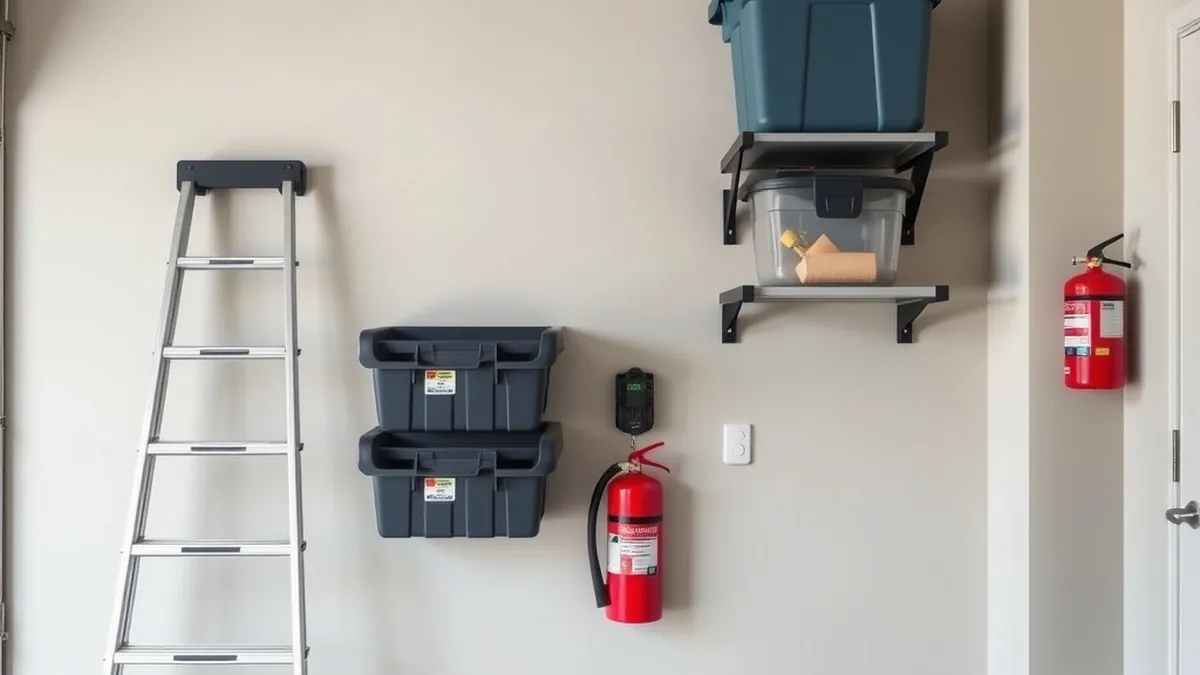
Check 12 things: anchors, load ratings, parking clearance, level racks, heavy-item placement, ladders, chemicals, ignition sources, the extinguisher, battery charging, child and pet access, and a twice-yearly inspection.
- Time per check
- About 20 minutes
- Minimum frequency
- Twice a year, plus after storms or leaks
- Overhead anchor
- Joists or rated structure only
- Ladder duty ratings
- Type II 225 lb, Type I 250 lb, Type IA 300 lb
- Walkway target
- 3 ft beside the car
Some links on this page are affiliate links.If you buy through them we may earn a commission at no extra cost to you. We do not accept payment for rankings. Read the full disclosure.
Most garage storage failures announce themselves first: a rack pulling away from a joist, a shelf bowing under paint cans, a ladder with a cracked foot. A 12-point check takes about 20 minutes and catches the problems while they are still cheap to fix.
A garage storage safety check is a scheduled inspection of the loads, anchors, clearances, and hazardous materials in the garage.
The 12-point checklist
- Every overhead load is anchored into joists or a rated structure, never drywall alone. Compare the fastener type with the rack’s instructions.
- The total load stays under the rack’s published rating. Weigh the bins once instead of guessing; as an estimate, a full tote can run 40 to 60 lb.
- Nothing hangs inside the parking envelope. Measure clearance with the car in place and the door fully open.
- Racks, shelves, and cabinets are level, and fasteners are snug but not overdriven. A rack that has moved a quarter inch needs a second look.
- Heavy items sit at or below waist height. Above eye level, keep only what you can lift with one hand.
- The ladder matches the job. Check the duty rating on the label and inspect the feet, rungs, and spreaders before climbing.
- Chemicals stay in original labeled containers, closed, and below eye level. Nothing goes into a food or drink container.
- Gasoline, propane, and solvents stay away from pilot lights, heaters, and battery chargers.
- A fire extinguisher rated for the garage’s hazards is mounted near the exit, and its gauge is checked monthly.
- Cords, chargers, and battery packs are not left on wood, paper, or sawdust, and are unplugged when unattended.
- Chemicals, sharp tools, and climbable stacks of bins stay out of reach of kids and pets.
- The garage gets a written inspection twice a year, plus after any leak, storm, or move.
Load limits: read the label, then do the math
The rating on the box may apply to the whole rack, to a pair of brackets, or to a single shelf. Read which one before you load it.
An example: twelve bins at 35 lb each weigh 420 lb. Add a 60 lb rack and the assembly is at 480 lb. If the published rating is 600 lb, that leaves 120 lb of margin, about 20 percent. If the same load sits on two brackets rated at 200 lb each, the brackets are the limit, not the rack.
Distributed load and point load are different questions. A 50 lb kettlebell in one corner of a shelf is harder on that shelf than 50 lb spread across four boxes.
Anchors: wood, masonry, and the drywall rule
Wood framing takes lag screws or structural screws driven into the center of the member, not near its edge. Pilot holes prevent splitting, and washers spread the load.
Concrete and masonry take anchors designed for masonry, not plastic plugs in mortar joints. Brick is not concrete, and hollow block needs a different anchor again.
Garage air is humid, and near the coast it carries salt. Use fasteners with a coating rated for the exposure, and replace any fastener that shows rust or a bent shank rather than reusing the hole.
Drywall anchors are for pictures and towel bars. No overhead storage load belongs on one.
Ladders and overhead reach
Step ladders carry a duty rating that includes the user and the tools: Type II at 225 lb, Type I at 250 lb, and Type IA at 300 lb. Check the label rather than guessing.
Set the ladder on flat ground and open it fully. For a leaning ladder, use the 4:1 rule: 1 ft of base distance for every 4 ft of height. Face the work, keep three points of contact, and stay off the top two rungs.
A step stool balanced on a rolling cart is not a ladder. Neither is a bucket.
Clearance and the parking envelope
Measure with the car parked where it actually parks. Most cars are 5 to 6 ft tall, and a garage door track or opener rail often sits at 6 ft 8 in to 7 ft. A rack that clears the roof can still be struck by an open hatch or by the door as it travels.
Leave 3 ft of walkway between the car and the storage wall, and keep the door’s swing and the opener’s path clear. Tape the parking spot on the floor so the envelope survives a tired Tuesday.
Fire, chemicals, and batteries
An attached garage is often separated from the house by a fire-rated assembly. Penetrations for racks and shelves should be sealed as that assembly requires, and the door needs its self-closing hardware to work.
Store chemicals in their original containers with the label intact, below eye level, and away from anything with a pilot light. Many codes and insurers restrict propane cylinders in garages, so check the cylinder and local rules.
Charge batteries on a hard, non-combustible surface, with the charger the manufacturer supplied, and not inside a closed cabinet. Unplug when the light turns green.
Kids and pets
Lock cabinets that hold chemicals, sharp tools, or batteries. Anchor tall cabinets and shelf units to the wall so they cannot tip when a child climbs.
Skip stacks of bins that make a staircase. Keep pet food in a lidded metal or heavy plastic container, and test the garage door’s safety reverse monthly with a small object.
Inspection schedule
Twice a year is the minimum. Spring and fall work well because both follow a season of temperature change. Add an inspection after a storm, a move, a leak, or any repair.
Look for rust streaks, pulled screw heads, sagging shelves, water stains, rodent droppings, and cracks that were not there last time. Write the date on the rack’s frame with a marker. A record makes the next check faster.
When to call a professional
Call a licensed contractor or structural engineer for cracks in framing, a ceiling that sags, a rack that has pulled loose, water intrusion, or any change to a structural member. New circuits, outlets, and hardwired lights go to a licensed electrician.
The ceiling types guide explains what the framing can reasonably carry. The overhead weight guide covers ratings and margin, and the small garage guide helps when the safe answer is less storage, better placed.
Frequently asked questions
How often should I inspect garage storage?
Twice a year at minimum, ideally in spring and fall, and again after a storm, a move, a leak, or any repair. Look for pulled fasteners, sagging shelves, rust, water stains, and pest evidence.
Can I store propane cylinders in the garage?
Many codes and insurers restrict propane cylinders in garages and other enclosed spaces. Check the cylinder label and your local rules, and never store one near a pilot light, heater, or charger.
What is the safest way to reach an overhead shelf?
Use a step ladder with a duty rating that covers you plus the load, set it on flat ground, and stay off the top two rungs. Never stand on a bucket, a rolling cart, or a shelf.
Are plastic storage bins safe in a garage?
Yes for most household goods, especially bins with gasketed lids. Do not use them for gasoline or solvents, and keep chemicals in their original labeled containers instead.
How much weight can a garage shelf hold?
Use the manufacturer's published rating for the shelf and its brackets. Ratings may apply per shelf, per pair of brackets, or to the whole unit, so read the label before loading.
Should a garage cabinet be anchored to the wall?
Yes. Tall cabinets and shelf units should be anchored to studs so they cannot tip, and any unit deeper than it is wide needs an anti-tip strap even when it feels stable.
Sources
Some links are affiliate links.If you buy through them we may earn a commission at no extra cost to you. We do not accept payment for rankings. Read the full disclosure.