Garage tool storage systems
Tool chests, cabinets, wall rails, and roll cabs compared on footprint, security, mobility, and the floor space your garage actually has.
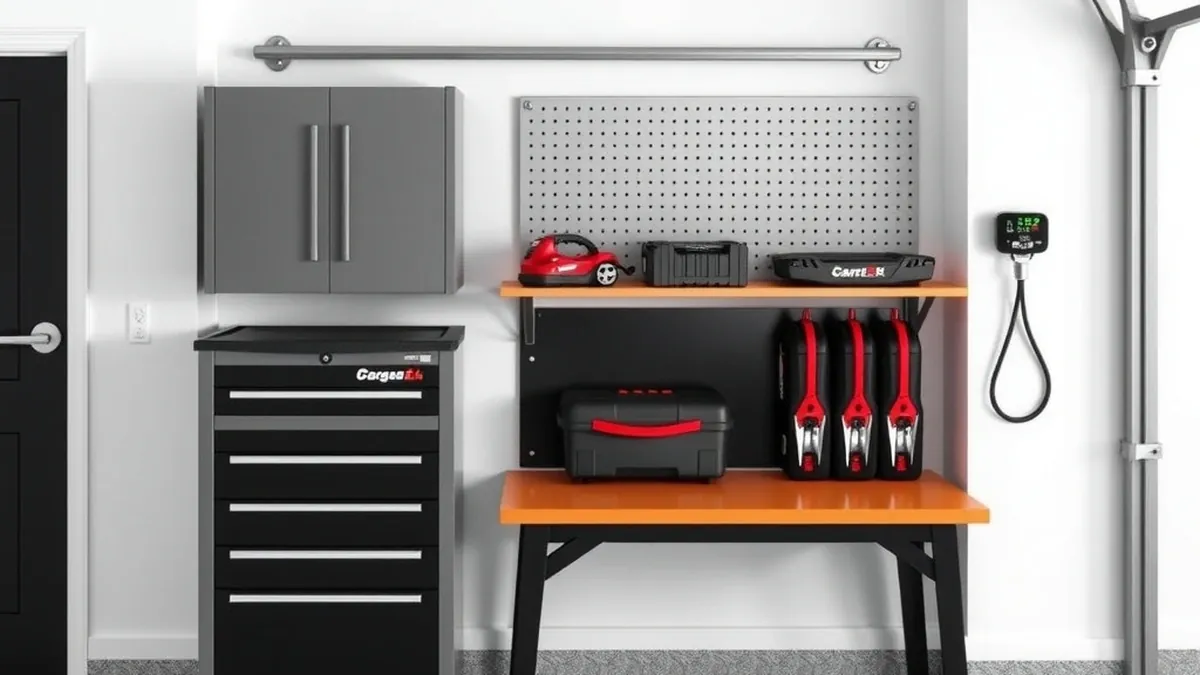
Wall rails free the floor, chests fit on a bench, cabinets lock and hold bulky items, and roll cabs move between bays. Choose by floor space and mobility, then drawer layout and lock, and anchor anything tall.
- Least floor space
- Wall rail or track system
- Best for bulky tools
- Lockable cabinet
- Best for one bay
- Tool chest on a bench
- Best for two bays
- Roll cab with locking casters
- Must-do
- Anchor tall units; charge batteries outside closed cabinets
Some links on this page are affiliate links.If you buy through them we may earn a commission at no extra cost to you. We do not accept payment for rankings. Read the full disclosure.
Every tool storage system is a trade between floor space, access, and security. A wall rail gives up security to free the floor; a roll cab gives up floor to keep everything within reach. The right answer starts with how many cars need to park.
Tool storage is any system that holds hand and power tools between jobs: a chest, a cabinet, a wall rail, or a rolling cabinet.
The four systems in one sentence each
A tool chest is a wide, shallow box of drawers that sits on a bench or a fixed base and stays put.
A cabinet is a tall lockable unit with shelves or drawers, sized for bulky tools, chemicals, and cases.
A wall rail is a track with hooks that moves tools off the floor and onto the wall.
A roll cab is a chest on casters, built to travel from one bay to the other.
Chests, cabinets, rails, and roll cabs compared
| System | Floor space | Mobility | Security | Best for |
|---|---|---|---|---|
| Tool chest | 26–41 in wide, bench height | None unless on casters | Keyed lock on most models | One bay, small tools |
| Cabinet | 24–36 in wide, 72–84 in tall | None | Lockable doors, hidden contents | Bulky tools, chemicals |
| Wall rail | None | None | None | Wrenches, clamps, frequently used tools |
| Roll cab | 26–56 in wide plus aisle | Locking casters | Keyed lock, some with drawer latches | Two bays, heavy tool sets |
Measure the aisle before the cabinet. A roll cab needs about 36 inches in front of the drawers, and a 24 inch deep unit against the wall eats half of a narrow bay.
Drawer math that predicts usable space
Drawer count tells you less than drawer area. A 26 inch wide chest with 16 inch deep drawers gives 416 square inches per drawer. A 41 inch wide chest at 18 inches deep gives 738 square inches, about 77 percent more per drawer.
Depth matters too. A 4 inch deep drawer at 26 by 16 holds about 1,664 cubic inches. The same drawer at 41 by 18 holds about 2,952. Five drawers at the smaller size total roughly 8,300 cubic inches; eight at the larger size total about 23,600.
That is why a wide chest usually beats a tall stack of narrow ones. It also explains why a fully loaded 41 inch chest can weigh 500 to 800 lb, an estimate that depends on what goes in it. That weight becomes a floor question.
Layout matters as much as volume. Deep drawers swallow cases and leave dead air above them, while shallow drawers keep sockets and wrenches in one visible layer. Measure the tallest tool you own before choosing a drawer depth.
Battery charging without the fire risk
Cordless batteries want a shelf, not a drawer. Give the charger 12 to 18 inches of depth, an outlet nearby, and open air around the battery.
Keep chargers out of closed cabinets, away from sawdust and paper, and on a hard surface. Use the charger that came with the battery, and follow the manufacturer’s temperature range; many lithium-ion packs should not be charged below freezing.
A power strip screwed to the wall is not a charging station. If the shelf needs four outlets, have an electrician add them.
Security: locks, visibility, and anchoring
The garage door is often the weakest opening in a house, so a tool lock is a delay, not a guarantee. Anchor the cabinet or chest to studs, and keep the most expensive tools in the unit that is least visible from the street.
Close the blinds or frost the garage windows if a full chest faces them. Record serial numbers and photograph the drawer layout for insurance. Check whether the homeowner policy covers tools in a detached garage, because some cap it separately.
A lockable cabinet also keeps children and visitors out of sharp tools and chemicals, which matters as much as theft.
Weight, casters, and the slab
A loaded roll cab concentrates its weight on four small wheels. At 800 lb total, each caster carries about 200 lb, and the two front casters take more when the drawer is open.
A garage slab on grade usually carries that, but cracks, a settled corner, or a thin apron slab are reasons to spread the load with a plywood pad or choose a fixed cabinet instead.
Casters also fail at thresholds. Measure the lip at the garage-to-house door and the apron at the vehicle door before buying a roll cab that has to cross either one.
Wall rails and the anchor question
A wall rail is only as strong as its fasteners. The track should span at least two studs, ideally three, with fasteners rated for the track and the wall.
Hooks carry their own limits, and those limits assume the load hangs straight down. A 60 lb tool on a 10 lb hook will bend the hook or pull the track, even if the studs are solid.
Keep heavy items low and close to a stud. Put rarely used tools on the top row and the daily set at chest height, where you can reach without a ladder.
What to buy first
If the floor is the constraint, buy the rail first and a shallow cabinet second. If the bench is the constraint, buy a chest that fits under or beside it. If two cars share the garage, a roll cab with locking casters is usually worth the extra cost.
Buy the lock and the anchor at the same time as the cabinet. A lockable unit that can tip is a hazard, and a heavy unit that cannot be locked is a target.
A sensible sequence is rail, then chest, then cabinet. The rail handles the tools you use weekly and costs the least per tool. The chest adds enclosed storage at bench height. The cabinet takes the cases, chemicals, and bulky items that do not fit a drawer. In a one-car garage, the small garage guide shows how a 26 inch chest and a 4 ft rail can replace a wide roll cab.
The short version
Rails free the floor, chests save depth, cabinets hide and lock, and roll cabs move. Measure the aisle, do the drawer-area math, anchor anything tall, and charge batteries in the open.
The workbench storage guide covers the bench and pegboard dimensions that surround a chest. The wall organizer guide compares track systems and hook ratings in more detail.
Frequently asked questions
Is a tool chest or a rolling cabinet better?
A chest is cheaper and sits on a bench or a fixed base, so it saves floor space. A roll cab costs more, holds more, and moves to the job, but it needs a clear aisle and a floor that takes the point load.
How much weight can a garage wall rail hold?
Use the track and hook ratings published by the manufacturer, and anchor the track into studs. A hook rated for 10 lb will not hold a 60 lb tool, no matter how strong the wall is.
Where should cordless batteries be charged?
On a hard, non-combustible shelf with airflow, using the charger the manufacturer supplied, and not inside a closed cabinet. Keep the area clear of sawdust and unplug chargers when they are not in use.
Are lockable garage cabinets secure enough for tools?
A lock deters an opportunist, not a determined thief. Anchor the cabinet, keep tools out of sight through windows, record serial numbers, and check whether your insurance covers garage contents.
How do I keep a tool chest from tipping?
Anchor it to wall studs, load the heaviest tools in the bottom drawers, and open one drawer at a time. A tall chest with all drawers open is front-heavy even when it is standing still.
How much floor space does a tool storage system need?
A wall rail needs none, a chest needs 26 to 41 inches of width, a cabinet 24 to 36 inches, and a roll cab needs its width plus a 36 inch aisle to open drawers and move around it.
Sources
Some links are affiliate links.If you buy through them we may earn a commission at no extra cost to you. We do not accept payment for rankings. Read the full disclosure.