How to store bikes in a garage
Hanging, wall mounts, floor racks, and pulley lifts compared by ceiling height, bike weight, and how often you ride. E-bikes need their own plan.
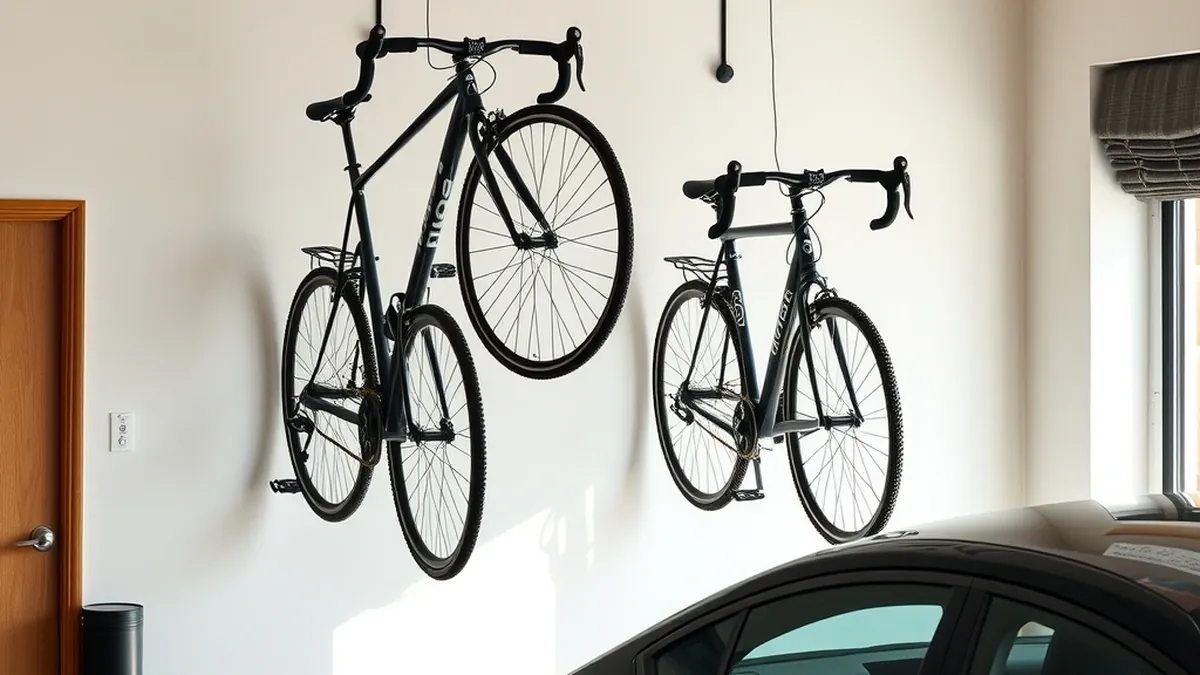
Hang a 25- to 35-pound bike from a hook at 7 feet or higher, or use a floor rack if the bike is heavy or used daily. E-bikes, at 50 to 80 pounds, should stay at floor level and never go on a single overhead hook.
- Adult bike footprint
- About 2 × 6 ft
- Bike drop below hook
- About 5 ft 4 in to the low point
- Hook height
- 7 ft minimum for a vertical hang
- E-bike weight
- 50–80 lb; floor storage
Some links on this page are affiliate links.If you buy through them we may earn a commission at no extra cost to you. We do not accept payment for rankings. Read the full disclosure.
A bike takes about 6 feet of wall or a 2-by-6-foot patch of floor. Which one you give up depends on the ceiling, the weight of the bike, and how often it moves.
Bike storage is any method that holds a bike off the floor — a hook, a wall mount, a stand, or a rack — and each one puts the load on a different structure.
Measure the bike, then the room
An adult bike is 68 to 72 inches long, 40 to 44 inches tall at the bars, and about 24 inches wide. A kids’ bike is 40 to 50 inches long and 15 to 25 pounds.
Weight matters more than dimensions. A road bike is 18 to 22 pounds, a hybrid 25 to 30, a mountain bike 30 to 35, and an e-bike 50 to 80. The method that works for 22 pounds is not automatically safe for 65.
Measure the ceiling at the spot where the bike will hang, not at the center of the room. Openers, ducts, lights, and the door track remove options that look available from the floor.
Ceiling height math
A bike hung vertically from its front wheel hangs about 5 feet 4 inches below the hook. At a 7-foot ceiling, that leaves roughly 1 foot 8 inches of floor clearance. At 8 feet, 2 feet 8 inches. At 9 feet, 3 feet 8 inches.
You also need clearance to lift the wheel onto the hook, and a 7-foot ceiling leaves little margin for a heavy bike. A 30-pound bike can be pressed up and hooked with two hands; a 65-pound e-bike cannot. That is the practical line between a hook and a floor rack.
Horizontal storage, with the bike hanging by both wheels, uses 6 feet of ceiling length and leaves the bike about 40 inches deep. It is easier to load than a vertical hook, but it blocks more ceiling and more light.
Methods, compared
The table compares methods rather than brands. A hook rated for 50 pounds is fine for a 30-pound bike and not fine for a 70-pound e-bike, even when the hook hangs from a joist.
| Method | Space used | Ceiling height | Lifting | Best for |
|---|---|---|---|---|
| Front-wheel hook | 2 × 6 ft | 7 ft and up | 25–35 lb | One adult bike |
| Two hooks, horizontal | 2 × 6 ft ceiling | 7 ft and up | 25–35 lb | Seasonal bike |
| Pulley lift | 3 × 6 ft | 8–9 ft | 30–40 lb | Heavy bike, low strength |
| Vertical wall mount | 2 × 6 ft wall | Any | 25–35 lb | No ceiling room |
| Floor stand | 2 × 6 ft | Any | None | Daily rider |
| Floor rack, 2–4 bikes | 4 × 8 ft | Any | None | Family |
| E-bike wheel tray | 2 × 6 ft | Any | None | 50–80 lb bikes |
A pulley lift is the only method that changes the lifting problem, because the rope takes the weight. It still needs a ceiling structure rated for the load, and the pulleys add hardware below the ceiling that a low bay may not have room for.
A tire hook is the common front-wheel hanger: a wide, coated hook that cradles the tire. Match the hook’s opening to the tire width, and use the hook’s published capacity rather than the wheel size as the limit.
Wall mounts and the stud question
Every wall mount needs a stud, and most need two. A vertical mount holds the bike by one wheel and cantilevers it 8 to 12 inches off the wall, which puts a pull-out load on the top fastener.
Use the bracket the manufacturer supplies, or a lag screw into the stud per the instructions. Do not use drywall anchors, and do not mount a rail to a single stud and hang two bikes from it.
On a concrete wall, use a rated masonry anchor. On steel studs, add a backing plate or a plywood panel screwed to the studs; the panel spreads the load and gives you a place to mount. If the wall is finished drywall over block, find the block, not the drywall.
E-bikes need a floor plan
An e-bike weighs 50 to 80 pounds, and the battery adds a dense mass that makes the bike awkward to lift. A single hook at 7 feet is the wrong tool.
Use a floor rack with a wheel tray, a ramp, or a stand that holds the bike by the frame. If the bike must go up a step, use a ramp rather than lifting it.
Follow the manufacturer’s instructions for the battery and charger. Do not store a charging battery under a rack or against a wall where a bike can fall on it.
Kids’ bikes and daily access
A kids’ bike is light enough to hang, and a hook at 5 to 6 feet keeps it within reach. The hook should be low enough for the child to reach with help, not so high that every ride becomes a request.
The bike used three times a week belongs on the floor. The bike used twice a season belongs overhead. Most garages have both, and the mistake is treating them the same.
Keep a 3-foot aisle in front of the rack so a bike can be rolled out without lifting it over another bike. That aisle is also the space a car door needs, so the bike zone and the parking zone have to be planned together.
Layout for a small garage
In a 12 by 20 with a car parked on one side, the free wall is usually 2 feet wide and 7 feet tall. That is enough for two vertical wall mounts or one floor stand, not a 4-bike floor rack.
Put the bike zone near the door, not at the back, because a bike that has to pass a car to get out will be left out. The small-garage layout guide covers the aisle math.
If the ceiling is low, read the low-ceiling guide before buying a pulley lift. A 7-foot ceiling does not leave room for the lift hardware plus the bike.
The short version
Hang bikes under 35 pounds from a hook into a joist or a wall mount into two studs. Use a pulley lift for a heavy bike only if the ceiling is 8 feet or more. Keep e-bikes and daily riders on the floor, leave a 3-foot aisle, and put the rack near the door.
Check the garage storage safety checklist for the anchor and inspection rules that apply to every method.
Frequently asked questions
How high should a bike hook be in a garage?
At least 7 feet for a vertical hang, with 12 to 18 inches of clearance to lift the wheel onto the hook. An 8-foot ceiling is more comfortable and leaves room to walk past.
Can I hang a bike from drywall?
No. The hook or mount must fasten into a stud or a joist. A bike plus the pull of a cantilevered mount is more than drywall can hold.
Can I hang an e-bike from a ceiling hook?
No. At 50 to 80 pounds, an e-bike is too heavy for a single overhead hook and too awkward to lift safely. Use a floor rack or a wheel-tray stand.
How much ceiling height do I need for a pulley bike lift?
Plan on 8 feet or more. The lift hardware takes 8 to 12 inches below the ceiling, and the bike needs another 3 feet of drop before it clears the floor.
Should bikes hang by the front wheel or both wheels?
A front-wheel hook is compact and works at 7 feet. Two hooks under both wheels keep the bike level and are easier to load, but they use more ceiling length.
Where should a bike rack go in a small garage?
Near the garage door, on the wall the car door does not open against. A bike that has to pass a parked car to get out tends to stay out.
Sources
Some links are affiliate links.If you buy through them we may earn a commission at no extra cost to you. We do not accept payment for rankings. Read the full disclosure.