Kayak storage in a garage
Ceiling slings, wall cradles, and floor racks compared by hull support, ceiling height, car clearance, and cost, with the measurements to take first.
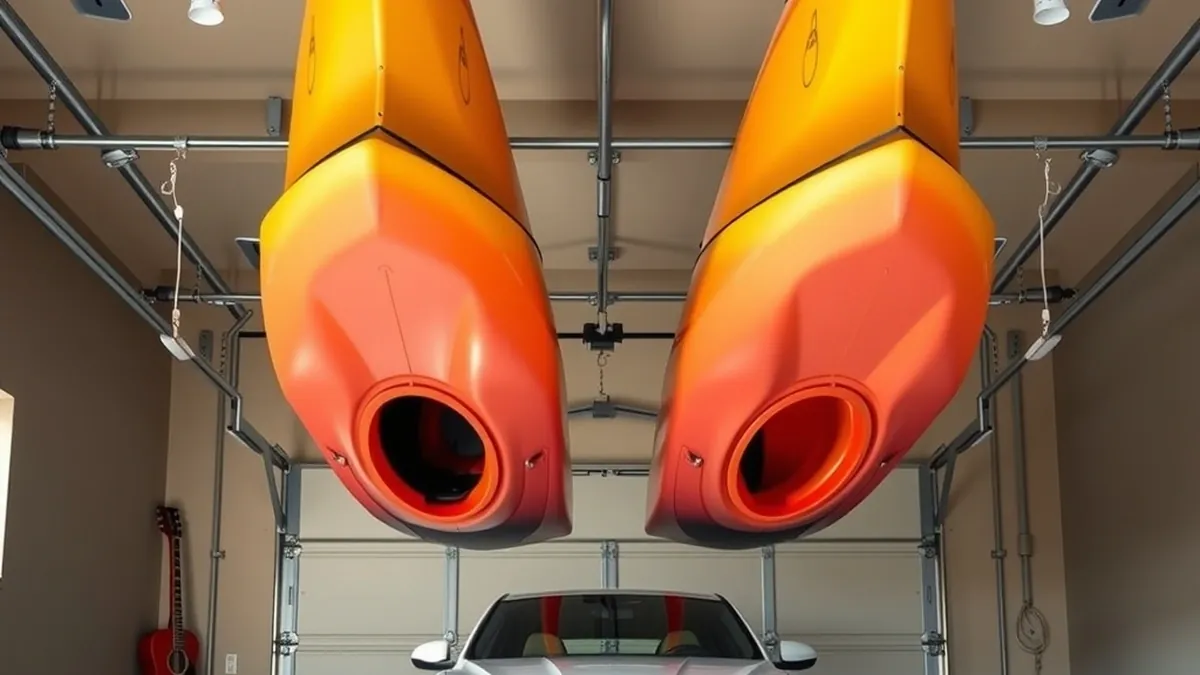
Hang a kayak from ceiling slings anchored into joists, or use two padded wall cradles at the hull's bulkheads. Support the hull at two wide points, keep the straps off the middle, and allow 12 inches above the car roof.
- Typical kayak
- 10 to 14 feet, 40 to 80 pounds
- Sling spacing
- At the bulkheads, about 3 to 4 feet from each end
- Ceiling
- 8 feet works for most slings; 7 feet is tight
- Car clearance
- 12 inches above the roof
Some links on this page are affiliate links.If you buy through them we may earn a commission at no extra cost to you. We do not accept payment for rankings. Read the full disclosure.
A kayak takes up 10 to 14 feet of wall or ceiling and weighs 40 to 80 pounds, so the garage is usually the only room that can hold it. The safe solution is two wide support points at the hull’s bulkheads, not one strap around the middle.
Kayak storage is the practice of supporting a hull at two structural points so it keeps its shape through heat, cold, and a long off-season.
Measure before you drill
Take three measurements before you buy a sling, cradle, or rack. First, the kayak’s overall length and its width at the cockpit. Second, the garage ceiling height under the joists, not the finished ceiling height at the walls. Third, the height of the tallest car that will park under the boat, measured at the roof rack or antenna.
Add the numbers. A 12-foot kayak hung with a 12-inch sling drop needs about 13 feet of horizontal run including the straps. On an 8-foot ceiling, a 12-inch sling drop and a 12-inch-deep hull leave about 6 feet under the boat before hardware. That is only about 6 inches above a 5-foot-6-inch sedan, so a 12-inch buffer may not be possible without a shallower drop or a lower car.
Also check the garage door. The door panels, tracks, torsion bar, and opener rail all move through the overhead zone. A kayak hung above the parked car can still be hit by the door if it crosses the door’s travel path. Open and close the door once with the boat in place before you commit to the location.
Support the hull at the bulkheads
A kayak is stiffest where the manufacturer bonded in a bulkhead or molded a structural wall. Those points are usually one-quarter to one-third of the length from each end. Supporting there lets the hull carry its own weight without flattening.
Use two wide straps or two padded cradles, each at least 2 inches wide. Rope, chain, or a single narrow hook concentrates the load and can leave a permanent dent. Spread the supports as far apart as the bulkheads allow, typically 6 to 8 feet on a 12-foot boat.
Plastic hulls soften in a hot garage. A strap tightened in July can leave a visible depression by September. Tighten only enough to stop the boat from rocking, and check the hull every few weeks during the first summer. Composite hulls are stiffer but can still crack if a support point lands on a hollow section.
Ceiling slings: the space-efficient default
A ceiling sling is two straps, each anchored to a joist, with a boat resting in the loop. The straps should be vertical or nearly vertical, not pulled inward, because an inward pull adds a squeezing force to the hull.
Anchor each strap into a joist with hardware rated for the load. Never anchor into drywall alone, and do not assume a finished ceiling hides adequate framing. If the joists run parallel to the boat, the two straps may land on the same joist or miss both; a spreader bar across three joists can solve that, but it is a structural attachment. Have a licensed contractor specify it rather than improvising with a 2-by-4.
A pulley hoist does the lifting for you. Look for a four-point lift with a published capacity above the kayak’s wet weight, a locking mechanism, and wide straps. A 60-pound kayak plus 10 pounds of straps and water needs a hoist rated well above 70 pounds; do not use a bicycle lift rated for 50 pounds.
Wall cradles: easier loading, more wall
Two wall-mounted cradles hold the boat horizontally at chest height and let you load from the side. Each cradle needs to be anchored into a stud, ideally with two fasteners per arm. The arms should be padded and shaped to the hull, not flat metal edges.
Space the cradles at the bulkheads, then check that the boat’s cockpit faces the wall or the aisle as you prefer. A cockpit facing the wall is harder to cover; a cockpit facing out is easier to inspect but catches dust. Either way, use a cockpit cover.
Wall cradles consume 12 to 18 inches of depth and 10 to 14 feet of wall, depending on the boat. That is often the best trade in a one-car garage because the wall above the car is otherwise unused. It also keeps the boat at a height where one person can lift one end at a time. If the room is tight, the small garage storage guide covers aisle and bay dimensions.
Floor racks and vertical storage
A freestanding floor rack holds two to four boats on padded horizontal bars. It needs a footprint of roughly 2 by 5 feet and does not require drilling, which makes it the rental-friendly option. The trade-off is floor space and a lower loading height.
Vertical storage leans the kayak on end against a padded wall or rack. It saves floor space but puts the hull’s weight on one end for months. Use it for short-term storage, pad the contact points, and strap the boat so it cannot slide. Do not store a plastic hull vertically in a hot garage and expect it to come back straight.
Compare the methods
| Method | Space needed | Hull support | Typical cost | Best for |
|---|---|---|---|---|
| Ceiling sling | Two joists, 8-foot ceiling | Two wide straps at bulkheads | $30 to $80 | One boat, car below |
| Pulley hoist | Two joists, 8-foot ceiling | Four-point lift | $100 to $250 | Heavy boats, one-person loading |
| Wall cradles | 10 to 14 feet of stud wall | Two padded arms | $60 to $150 | Easy side loading |
| Floor rack | About 2 by 5 feet of floor | Two or four padded bars | $150 to $400 | Two or more boats, rentals |
| Vertical lean | 2 by 2 feet of floor and wall | One padded end | $20 to $60 | Short-term only |
Prices are typical retail ranges for hardware, not installation. Professional hoist installation adds $150 to $400 locally.
Clearance is the expensive mistake
The most common garage kayak mistake is hanging the boat where the garage door opens, not where the car parks. Measure with the car in the bay, the garage door open, and the kayak loaded. Leave 12 inches between the lowest point of the hull and the highest point of the car, including roof racks and open hatchbacks.
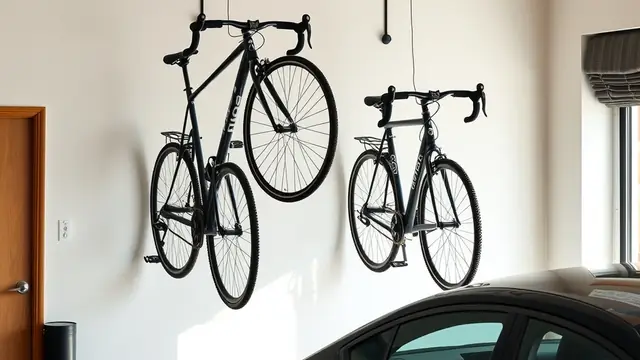
On a 7-foot ceiling, a sling drop of 12 inches plus a 12-inch hull leaves about 5 feet under the boat. That is below the roof of many crossovers and too low to walk under comfortably. The low-ceiling garage guide covers wall-mounted alternatives, and the bike storage guide shows how to share the same ceiling zone with another hobby.
If you are hanging anything overhead, anchor into joists or a rated structure and follow the hardware’s load rating. For a ceiling with cracks, sag, or unknown framing, call a licensed professional before drilling.
The short version
Measure the kayak, the ceiling, and the car. Support the hull at two bulkheads with wide straps or padded cradles, not one rope around the middle. Use a sling or hoist rated above the boat’s wet weight, anchor into joists, and keep 12 inches of clearance above the car. Store vertically only for short periods. If the ceiling is low, use wall cradles and keep the floor clear.
Whatever method you choose, check the garage storage safety checklist before you load it.
Frequently asked questions
Can I store a kayak on the garage floor?
Yes, if it sits on a padded rack or two wide foam blocks rather than directly on concrete. Keep it off the slab, out of walking paths, and away from the garage door's travel.
How high should a kayak be hung in a garage?
Aim for 12 inches above the roof, but an 8-foot ceiling may not allow it: a 12-inch drop leaves only about 6 inches above a 5-foot-6-inch car. Measure the car and the hull before you commit.
Will ceiling straps damage a kayak hull?
Wide straps placed at the bulkheads spread the load and are less likely to deform a hull than narrow rope around the middle. Plastic hulls soften in heat, so avoid overtightening and do not leave a strap on a hot hull for months.
How much weight can a garage ceiling hold?
That depends on the joist size, span, and condition, not on a generic number. Use a sling or hoist rated for the kayak's weight, anchor into joists, and have a professional assess the ceiling if you are unsure.
Can I store a kayak vertically?
Only short-term and with padding at the contact points. Long-term vertical storage puts the hull's weight on one end, which can cause oil-canning or distortion, especially in a hot garage.
How do I keep mice out of a stored kayak?
Cover the cockpit, open the drain plug, remove food and bait, and check the hatch areas before the season starts. A fitted cockpit cover keeps leaves and nesting material out without sealing in moisture.
Sources
Some links are affiliate links.If you buy through them we may earn a commission at no extra cost to you. We do not accept payment for rankings. Read the full disclosure.