Storing holiday decor in a garage
How to keep holiday bins, trees, and lights dry, pest-free, and under the overhead weight limit, with a container table and a workable access order.
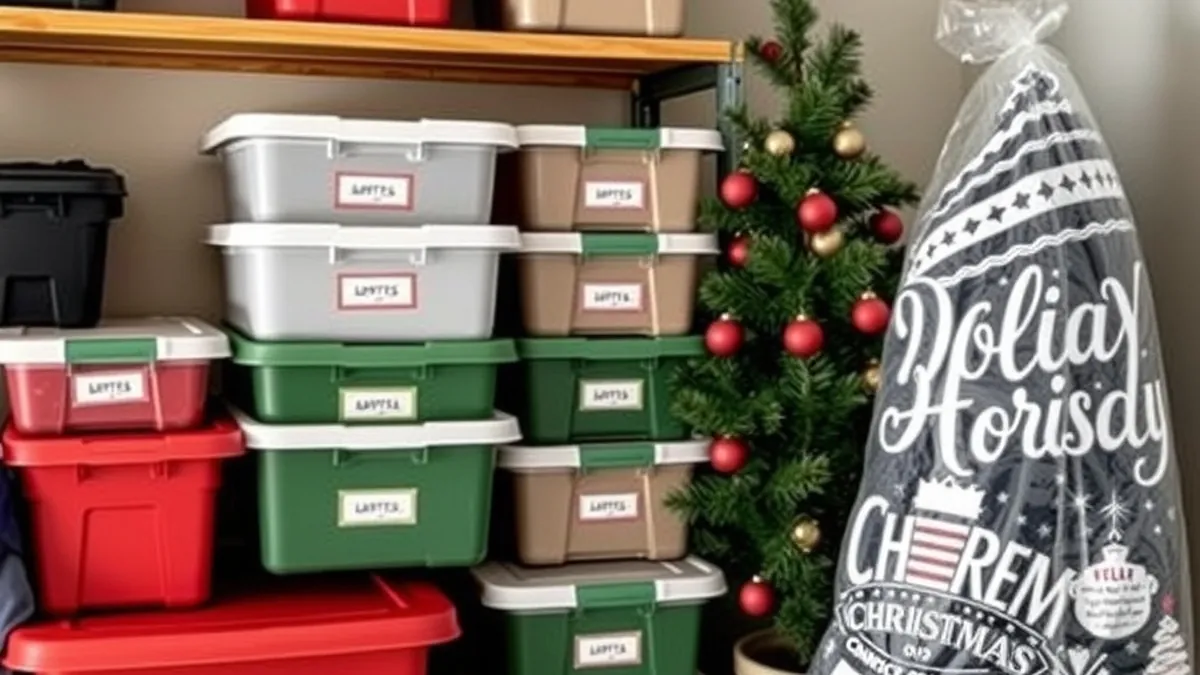
Store holiday decor in latching, labeled bins kept 4 to 6 inches off the slab, away from the garage door's heat and damp. Keep the tree dry, put heavy bins low, and never hang a loaded tote from drywall.
- Floor gap
- 4 to 6 inches off the slab
- Humidity target
- Below 60% where possible
- Overhead load
- The rack's published rating, with reserve
- Label format
- Holiday, contents, year, fragility
Some links on this page are affiliate links.If you buy through them we may earn a commission at no extra cost to you. We do not accept payment for rankings. Read the full disclosure.
Holiday decor survives a garage when you treat the garage as a humid, hot, pest-accessible space rather than an extra closet. Most failures come from three things: cardboard on concrete, a tree packed damp, and too much weight hung overhead.
Holiday decor storage is the practice of packing seasonal items so they stay dry, pest-free, and intact through a year of garage temperature swings.
The garage is not a closet
A garage slab wicks moisture from the ground, and the room’s relative humidity moves with the weather. In a humid climate, the concrete can stay damp for weeks. In a cold climate, freeze-thaw cycles push moisture through the slab and condense it on anything sitting directly on the floor. A $10 hygrometer takes the guesswork out of it; keep the room below 60% relative humidity where you can.
Heat is the second problem. The wall beside a west-facing garage door can exceed 100 degrees Fahrenheit on a summer afternoon, even when the outside air is in the 80s. Wax candles soften, adhesive labels curl, and batteries leak in that heat. Keep candles, batteries, and anything with adhesive indoors.
Pests are the third. Cardboard is a nesting material for mice and a sponge for moisture. Fabric wreaths, dried natural garlands, and anything with a food residue are attractive too. The floor is the wettest and most accessible plane in the room, so it is the worst place for a box you will not open for 11 months.
Choose containers by what they keep out
A container does not need to be airtight. It needs to resist dust, splashes, and rodents, and it needs a lid that stays put when the bin is stacked. Clear bins make inventory easier; opaque bins hide clutter and block light that can fade fabric.
| Container | Best for | Weak point | Typical cost |
|---|---|---|---|
| Clear latching tote, 66 qt | Ornaments, fabric, table linens | Can crack in extreme cold | $15 to $25 |
| Opaque latching tote | Lights, gift wrap, soft garlands | Hides contents without a label | $12 to $20 |
| Original cardboard box | Tree sections, bulky packing | Absorbs moisture, invites pests | Free |
| Canvas tree bag | Artificial tree | Not pest-proof or waterproof | $20 to $40 |
| Divided ornament organizer | Glass and fragile ornaments | Bulky for the volume it holds | $20 to $35 |
| Wreath box | Wreaths and garlands | Crushes if stacked | $15 to $30 |
For most households, one 66-quart latching tote per holiday is enough. A stack of mismatched cardboard boxes is not cheaper once you replace the items inside it.
Label for the person unpacking in December
Label the lid and two sides of every bin with the holiday, a short contents list, and the year packed. “Xmas” is not a label; “Christmas — tree lights, extension cords, spare bulbs — 2026” is. Add “fragile” to ornament bins and “heavy” to anything over about 30 pounds.
Color-code by holiday if you store several: red and green for Christmas, orange for Halloween, blue for winter. Keep a paper inventory taped inside a cabinet door or on the wall at eye level. When you add or remove an item, update the list with a pencil. The point is to avoid opening six bins to find one wreath hook.
Store the tree without trapping moisture
An artificial tree should be fully dry before it goes into a bag or box. If the tree came in from a damp garage or was wiped down, let it air out indoors for a day first. A closed bag holding residual moisture is a mold chamber. Loosen the branches, fold them naturally rather than forcing them, and use a bag with a handle so two people can move it.
A 7.5-foot artificial tree typically weighs 20 to 35 pounds, and the bag adds a couple more. Store it upright if the bag allows, or lay it flat on a shelf rather than on the slab. Keep the stand and hardware in a separate labeled bin so the tree bag does not become a grab bag of sharp bolts.
A real tree should never be stored. It dries into a fire load, drops needles, and attracts pests. Remove it after the holiday and take it to a municipal recycling program. The same rule applies to fresh wreaths and garlands: compost them, do not archive them.
Overhead space has a weight budget
Overhead is the right place for light, bulky items: the tree, wreaths, empty bins, and wrapping paper. It is the wrong place for toolboxes, paint, or anything you need to lift with one hand while standing on a ladder.
Run the arithmetic before you load a rack. A 66-quart tote packed with ornaments and fabric weighs about 30 pounds. Twelve of those is 360 pounds. Add a 25-pound tree and a 15-pound light bin and you are at 400 pounds. If the rack is rated 600 pounds for contents, that leaves 200 pounds of reserve, which is reasonable for awkward loads. If the rack is rated 300 pounds, the same load is already over the limit.
Ratings assume the rack was installed into joists or a rated ceiling structure, not drywall. If you are unsure what the ceiling is made of, stop and read how much weight overhead storage can hold before you buy hardware. The garage storage safety checklist covers the rest of the anchorage questions.
Load storage in access order
Arrange storage by the date you will next open it, not by the size of the bin. The items you need on December 1 go at eye level and near the front. The items you need in January go one shelf back. Off-season holidays go higher or deeper.
- Put the tree and light bins at the front edge of the overhead rack.
- Put ornaments at waist-to-eye height, where you can lift them down without a ladder.
- Put heavy bins on the lowest shelf, ideally between 12 and 48 inches off the floor.
- Put off-season holidays at the back of the top shelf, labeled on the shelf edge.
- Keep a 36-inch aisle so you can pull a bin straight out instead of twisting it.
In a small garage, the same order works on a single wall: the current holiday occupies the accessible third, and everything else stacks behind or above it. The small garage storage guide has layout dimensions if the wall is tight.
The short version
Use latching bins, not cardboard. Keep everything 4 to 6 inches off the slab. Label the lid and at least two sides. Dry the tree before bagging it, and never store a real tree. Keep overhead loads inside the rack’s published rating and anchored into joists. Load the storage in the order you will open it.
If you are adding a rack, a shelf, or any structural attachment, anchor into joists or studs and follow the manufacturer’s load rating. For a sagging ceiling, a crack, or a change to the structure, call a licensed professional.
Frequently asked questions
Can holiday decorations be stored in a garage?
Yes, if the bins are latching, raised off the floor, and kept away from heat and water. The garage is a harsher environment than a closet, so cardboard and open boxes are poor choices.
How do I keep ornaments from breaking in a garage?
Use a divided ornament organizer, wrap glass pieces individually, and do not stack heavy bins on top. Keep glass ornaments on a shelf rather than on the floor, where vibration and moisture are worst.
Should I store a Christmas tree in the garage?
An artificial tree can be stored in the garage once it is fully dry and bagged. A real tree should not be stored at all; remove it after the holiday and take it to a municipal recycling program.
How much weight can garage overhead storage hold?
Use the rack manufacturer's published rating and anchor the rack into joists, never drywall. Treat the rating as a ceiling for the contents, keep a reserve for awkward loads, and do not exceed it.
How do I stop mice from getting into holiday bins?
Use latching bins with tight lids, eliminate cardboard, keep bins off the floor, and set traps along the wall where rodents travel. Avoid rodenticide where children or pets can reach it.
What temperature is too hot for holiday decorations?
Treat anything above 100 degrees Fahrenheit as risky for wax candles, adhesives, electronics, and batteries. The wall next to a west-facing garage door can run much hotter than the middle of the garage.
Sources
Some links are affiliate links.If you buy through them we may earn a commission at no extra cost to you. We do not accept payment for rankings. Read the full disclosure.