Garage wall storage ideas that scale
Rails, slatwall, pegboard, and cabinets compared by depth, anchoring, and what each holds. Start with the wall audit, then add the system that fits.
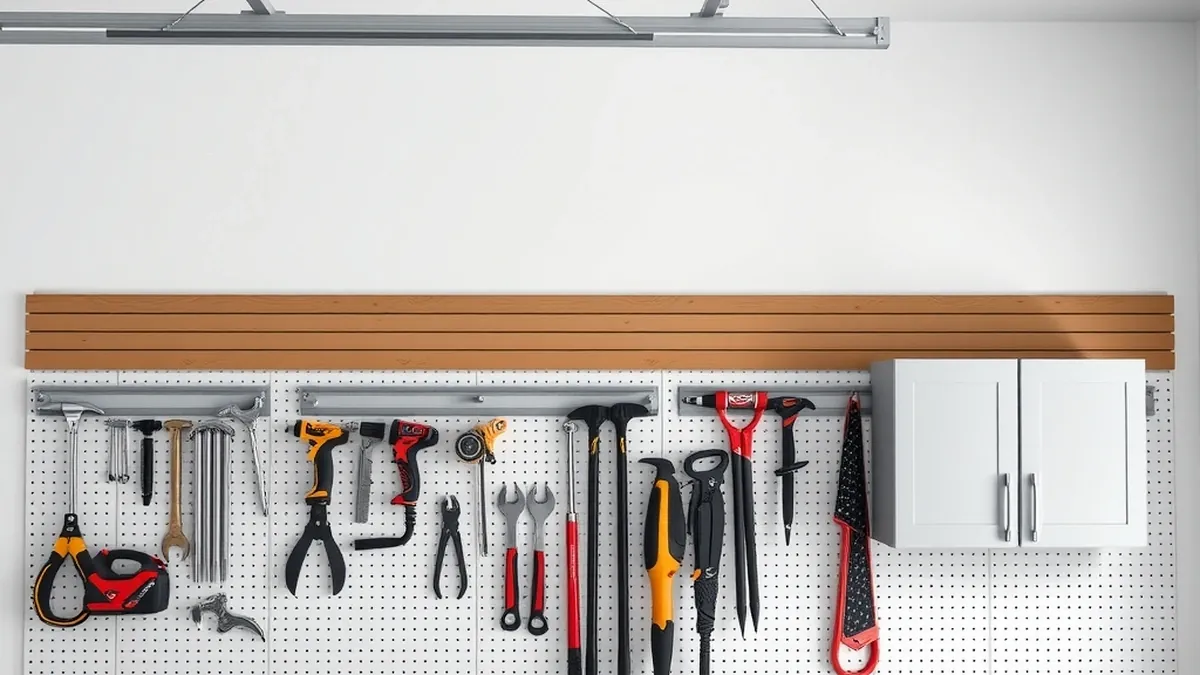
Start with a wall rail if the wall is short and the load is light. Slatwall holds more per square foot, pegboard is for small tools, and cabinets hide the clutter but take 12 to 24 inches of depth.
- Lowest cost
- Hook strip or wall rail
- Highest density
- Slatwall with mixed inserts
- Best for tools
- Pegboard or a tool cabinet
- Most floor lost
- 24-inch-deep cabinets
Some links on this page are affiliate links.If you buy through them we may earn a commission at no extra cost to you. We do not accept payment for rankings. Read the full disclosure.
Wall storage is the cheapest square footage in a garage and the easiest to get wrong. The systems look similar in a photo; they differ in depth, anchor pattern, and how much weight each hook actually carries.
Wall storage is any system mounted to the wall framing, from a single hook strip to a full cabinet run, that carries load through fasteners into studs rather than through drywall.
Audit the wall before you buy
Find the studs before you shop. Studs are usually 16 or 24 inches on center, and the spacing changes how many fasteners a 4-foot panel gets. At 16 inches, a 4-foot panel crosses four studs; at 24 inches, three.
Note the obstructions: the garage door track, the opener rail, the electrical panel, the water heater, hose bibs, and any window. A 4 × 8 panel needs a clear rectangle, and a panel that covers the electrical panel or the shutoff is a problem.
Check the wall height. A 7-foot wall takes a 72-inch cabinet and leaves 12 inches; an 8-foot wall takes an 84-inch cabinet. The top 12 inches are usually the most wasted space in the garage.
The systems at a glance
The table compares how each system mounts and what it is good for. The capacity always comes from the manufacturer’s label on the hook, bracket, or shelf, not from the size of the panel.
| System | Depth | Anchor pattern | Load basis | Best for |
|---|---|---|---|---|
| Hook strip | 1 in | 2 or more studs | Per hook | Light hand tools |
| Wall rail | 1–3 in | 2 or more studs | Per hook or bracket | Bikes, long tools |
| Slatwall | 1–3 in | Every stud crossed | Per panel and insert | Dense, changing storage |
| Pegboard | 1/2 in | Furring at 16 in | Per hook | Small tools |
| Wall cabinet | 12–24 in | 2 or more studs, anti-tip | Per shelf | Boxed, hidden storage |
| Shelving | 12–16 in | Brackets at studs | Per shelf | Bins and bulk goods |
Wall rails: the fastest start
A rail is a horizontal channel screwed into two or more studs, with hooks that clip anywhere along it. It is the cheapest system per foot and the easiest to reconfigure.
The rail does not carry the load; the hooks do. A 48-inch rail into two studs is only as strong as its fasteners and the hooks, so check the hook rating and put the heaviest item over a stud.
Use two rails at different heights: 5 feet for daily tools and 6 feet for seasonal items. On a 7-foot ceiling, the upper rail should stay at 6 feet so you can reach it without a ladder.
Slatwall: density with a catch
Slatwall is a panel with grooves, usually 3 to 6 inches on center, that accept hooks and shelves. It covers a wall in a uniform grid, so you can move a hook without patching holes.
It also costs more than a rail and takes 1 to 3 inches of depth. The panel must be screwed into every stud it crosses, not just the ends. A panel held by four screws at the corners will sag between them, and a sagging panel puts the load on the drywall.
Check what the panel is made of. PVC slatwall is light and moisture-resistant; MDF and melamine are heavier and swell if they get wet. The insert rating, not the panel thickness, sets what a hook can hold.
Pegboard: tools only
Pegboard is 1/8- or 1/4-inch board with holes on 1-inch centers. It is cheap, replaceable, and good for screwdrivers, pliers, and small hand tools.
It is not a structural panel. A 20-pound framing nailer on a single peg hook can pull the hook out or tear the board. Keep each item to a few pounds and use two hooks for anything long.
Mount pegboard on 1 × 2 furring strips so there is air behind it for the hooks. Screw the furring into studs, not into drywall.
Cabinets: the closed option
A wall cabinet 12 inches deep holds paint cans and small bins; 18 inches holds power tools; 24 inches holds almost anything and costs 2 feet of floor width.
Do the arithmetic. A 30-inch-wide, 24-inch-deep, 72-inch-tall cabinet is about 30 cubic feet. The same wall space in 12-inch shelves is about 15 cubic feet, but the shelves are open and you can see everything.
Wall cabinets need two studs and an anti-tip strategy. Hanging a 100-pound cabinet from two screws into one stud is a falling hazard, not storage.
Zone the wall by reach
Divide the wall into three bands. From 0 to 3 feet, use floor cabinets, rolling bins, and anything heavy. From 3 to 6 feet, put daily tools, bike helmets, and the things you touch every week. From 6 feet to the ceiling, put seasonal and light items.
Then group by activity, not by object type. Bike gear near the garage door, garden gear near the side door, tools near the bench. A wall organized by category but not by use will be reorganized within a month.
Draw the wall on paper in 4-foot sections and mark the studs. It takes ten minutes and prevents the most common error: a cabinet centered on a window or a rail that ends between studs.
Studs, anchors, and load limits
Every system in this guide depends on the same rule: anchor into studs, and follow the rating. Drywall anchors are for pictures, not for a bike or a cabinet.
Use the fastener the manufacturer specifies. For most rails and cabinets that is a lag screw or a structural screw into the center of a stud, with two fasteners per bracket.
A rail that spans one stud is a lever. A shelf bracket at the end of a run with no stud behind it will pull out. If the studs are not where you need them, add a plywood backer screwed to the studs and mount to the backer.
Check the label on every hook, bracket, and shelf. A hook that looks heavy is not a rating. If the package does not state a capacity, treat it as light-duty.
The short version
Start with a rail if the wall is short or the budget is tight. Use slatwall when the wall is long and the storage will change. Use pegboard for small tools and cabinets for anything you want to hide. Anchor everything into studs and keep the top band for light, seasonal items.
In a 12 by 20, the wall is the only free direction, and the small-garage guide shows the depth math. The slatwall vs pegboard comparison goes deeper on the two panel systems, and the best wall organizer roundup covers specific products.
Frequently asked questions
What is the best wall storage for a garage?
A wall rail is the best first system for most garages: it is cheap, fast to install, and holds bikes and long tools. Add slatwall or cabinets when the load or the clutter grows.
How do I find studs behind garage drywall?
Use a deep-scan stud finder and confirm each hit at two points. A magnet that finds drywall screws also works. Check the spacing from the attic or a removed outlet cover when you can.
Can I mount a wall rail to drywall only?
No. The rail must be screwed into studs, and the hooks must be rated for their load. Drywall anchors are for pictures, not for bikes, ladders, or cabinets.
Is slatwall stronger than pegboard?
Yes, in general. Slatwall spreads load through a groove and a metal insert, while pegboard hangs load on a small hook through a thin board. Pegboard is for light tools only.
How deep should garage wall cabinets be?
Twelve inches for paint and small bins, 18 inches for power tools, and 24 inches for bulky items. On a 12-foot-wide garage, 24 inches on the parking side usually blocks the car door.
How high should wall storage go?
Keep daily items between 3 and 6 feet, and put light, seasonal items above 6 feet. The top 12 inches of a garage wall are usually empty and are the cheapest space to use.
Sources
Some links are affiliate links.If you buy through them we may earn a commission at no extra cost to you. We do not accept payment for rankings. Read the full disclosure.